Begin deze week kreeg ik een mail van de hoofdredacteur en baas (zijn uitdrukking) van het BoeddhistischDagblad, Joop Ha Hoek, waarin deze mij verbood nog langer de in zijn ogen zieke stukjes te plaatsen zoals ik omtrent de jaarwisseling kennelijk heb gedaan. Of het een volledige ban is, weet ik eigenlijk niet, misschien worden brave (positieve, adorerende) stukjes van mij nog wel opgenomen maar dat ga ik niet proberen.
Omdat waarschijnlijk de mededeling van deze mail aan mij niet aan de BD-lezers wordt gemeld, geef ik een aantal van de meest relevante passages eruit weer:
“From: boeddhistischdagblad@xxx
To: jwromeijn@xxx
CC: edje2002@xxx; xxx@onkruid.nl; ujukarin@xxx; andre@xxx; pauladewys@xxx; info@tilanusxxx; reinier@tilanusxxx; xxx@bosrtv.nl; vanbuuren@xxx; d.varamitra@dji.minjus.nl; varamitra@xxx; varamitra@xxx
Subject: Joop Romeijn, de BUN en de Dalai Lama
Date: Mon, 6 Jan 2014 16:52:43 +0100
Goedemiddag Joop, ik ken inmiddels via verschillende publicaties -in onder meer jouw weblog- jouw obsessieve gedachten en ideeën over de BUN, BOS, BZI en academische opleiding geestelijke verzorgers. Het staat je vrij die te hebben, voor mij zijn het meningen van een privépersoon, niet geënt op realistische omstandigheden. De vrijheid om je te uiten wordt echter ingeperkt als je meent de kolommen van het Boeddhistisch Dagblad daarvoor te kunnen misbruiken. In recente publicaties in mijn krant –onder meer het bezoek van de Dalai Lama aan Nederland- voerde je (het voortbestaan van) de BUN op, gekoppeld aan de functies en over de ruggen heen van Paula de Wys en Reinier Tilanus. Zo bezoedelde je een mooi bericht over een mooi mens. Ik vind dit werkelijk ziekmakend.
In plaats van dat je blij bent dat er mensen zijn die naast hun werkzaamheden voor de BUN ook nog belangeloos het bezoek van de Dalai Lama aan ons land voorbereiden en ze daarvoor het respect geeft dat ze verdienen, schok je hen en anderen met je misselijkmakende en zieke gedachten over de BUN. Want dat is waar het om gaat. Een paar dagen geleden meende je Ujukarin in een reactie een vermeend voorzitterschap van de BUN toe te moeten dichten.
En nog wat langer geleden meende je …. te moeten diskwalificeren.
...
Als baas van het Boeddhistisch Dagblad ontzeg ik je nu de mogelijkheid om in mijn krant dergelijke uitlatingen te publiceren. Het zijn gedachtenspinsels van een man met een haatdragende geest die de toekomst naar zijn hand wil zetten. Je beschadigt er bewust goedwillende en liefdevolle mensen mee, die hun vrije tijd belangeloos steken in het boeddhisme en de verschillende organisaties.
…
Mijn mail aan jou komt stand zonder ruggenspraak met de BUN of wie dan ook. Ze vertolken mijn persoonlijke gevoelens en die van mij als hoofdredacteur van deze krant en worden op eigen initiatief en met de beste intentie weergegeven.
Ik wens je een goed 2014.”
======================================================
Als mogelijke laatste keer een paar reacties van mij, zonder reacties van anderen (die zijn in het BD te lezen; vooral blijven doen, dan weet u wat er in het lieve deel van boeddhistisch Nederland leeft).
Twee maal op boeddhistischdagblad.nl/dalai-lama-bezoekt-begin-mei-2014-nederland/, van 27 en van 30 december 2014:
“ Goed nieuws voor alle geïnteresseerden in het boeddhisme en alle beoefenaren ervan, met name die van het Tibetaans boeddhisme.
Een belangrijk verschil met het vorige bezoek is ook dat de Dalai Lama niet langer de politiek leider van de Tibetanen (in ballingschap) is, dat is sinds zomer 2011 de verkozen Lobsang Sangay.
De Dalai Lama kan nu komen als boeddhist en als spiritueel leider van de Tibetaanse boeddhisten. Voor ons als aanhangers van de scheiding van kerk en staat is dat wel zo zuiver. “
…
“ Paula de Wys en Reinier Tilanus worden met name genoemd als organisatoren van dit gebeuren; daar zullen ze hun handen vol aan hebben in 2014. Ik wens ze sterkte.
Ze zijn echter ook BUN-bestuurslid, daar zullen ze dus geen tijd voor hebben.
Bovendien hebben we eerder in het BD gelezen dat de voorzitter van de BUN komend voorjaar vertrekt en de penningmeester al eerder. Wie blijft er nog over?
Het werk lijkt nu al stil te staan, we hebben (in het BD) niets van de ledenvergadering afgelopen najaar gelezen, vroeger was dat wel het geval. De VU kan bv nu al volledig haar gang gaan met de opleiding tot ‘buddhist chaplain’ zondere publieke boeddhistische controle (Of werkt de Dhamma Advies Raad wel?)
Straks stopt de BUN er nog eerder mee dan ik voorspeld had, namelijk eind 2015 als hun omroeplicensie afloopt op grond waarvan de BOS kan uitzenden. Dat mag toch niet gebeuren?
Ik wens eenieder een goed 2014 toe. “
Een paar reacties van mij op boeddhistischdagblad.nl/siddhattha-gotama-de-boeddhist-2/
van 1, 3 en 4 januari 2014 (een reactie op Jules Prast heb ik in m'n vorige blog opgenomen, de opmerking over 'onwetendheid' is eigenlijk ook aan hem gericht, want hij benadrukt nogal het 'niet weten'. )
“Ook een gelukkig nieuwjaar aan allen! Dat het opnieuw een jaar mag worden van verminderde onwetendheid (avijja).
Robert, ik had me kunnen voorstellen dat je niet had gereageerd omdat André schrijft als de traditionele Aziatische leraar, ponerend zonder zichtbare interesse in discussie of tegenspraak.
Ik kan me echter ook voorstellen dat je wel heb gereageerd. Alleen schiet je wat door als je over de ‘Sankriet Canon’ schrijft, alsof er een homogeen en ongeveer tegelijkertijd gecomponeerd geheel van teksten is.
Sommige Mahayana-teksten zijn van voor onze jaartelling en sommige van (eeuwen) na onze jaartelling. Sommige zijn in het Sanskriet geschreven en later in het Chinees vertaald, sommige zijn oorspronkelijk Chinese composities zoals de Hart Sutra (en misschien geldt dat ook wel voor Tibetaans, daar weet ik te weinig van).
Ditzelfde geldt voor de Pali Canon; al denk ik wel dat de gemiddelde leeftijd daarvan wat hoger is; maar ook hier is er sprake van voor (misschin 400 jaar voor, misschien 100 jaar voor) en teksten na onze jaartelling.
Maar wat doet dat er toe? Theravada en Zen zijn toch gewoon twee verschillende religies (of filosofieën); net zo als Nichiren en Tibetaans boeddhisme dat zijn? Ze hebben maar twee zaken gemeenschappelijk: het gebruik van de naam ‘Boeddha’ en de neiging om hun teksten ouder te laten lijken dan ze zijn: te antedateren
Wij zijn dol op authenticiteit, waarbij het lastig is dat dat twee betekenissen heeft:
- zuiver, direct uit het hart komend
- oorspronkelijk en dus uit de oudheid komend.
Die twee zijn wat lastig te verenigen, dat is het hele probleem. “
Op een reactie van Ujukarin:
“Schitterend, ik zou haast zeggen: hier spreekt de nieuwe BUN-voorzitter
Terecht leg je nadruk op de sangha, in plaats van op de leraar zoals velen helaas doen.
Alleen vind ik je wel wat oordelend als je zegt “wie … niets van Vriendschap/Sangha respecteert is dus m.i. ook geen volgeling van de Dhamma “. Zelfs als je het teveel gebruikte woord ‘respecteren’ vervangt door bv ‘nodig denkt te hebben’, dan nog vind ik deze laatste zin van je heldere betoog overbodig.”
En idem van 4 januari:
“Waarom niet, je naam wordt genoemd, het is maar voor twee jaar, Ujukarin?
Nu de kern: ik ben het wel met je eens dat samen beoefenen essentieel want verrijkend (mudita-gevend) is, maar wil een anderen uitsluitende zin als 'ik herken ze niet als mede-gangers op het pad' niet voor m’n rekening nemen.
En uiteindelijk moet men ook z’n groep durven kunnen loslaten.
Geheel terzijde, voor de liefhebbers van de Hart Sutra (u weet wel, van ‘Vorm is leegte’), een variant gecomponeerd in de 20e eeuw van onze jaartelling:
”The Hard Sutra
Thus have I heard. At one time the Blessed One was staying at Savatthi,
in Jetavana, Anathapindika’s Park. ‘Monks,’ the Blessed One addressed
the community of monks. ‘Yes, Blessed One,’ the monks replied. The
Blessed one stated: ‘Monks, there is but one way to learn and that is the
hard way. Do not be deceived.’ The monks rejoiced at the Blessed One’s words. ”
‘De harde weg’, daar houden sommige beoefenaren vast niet van. “
======================================================
Tot zover deze citaten van mezelf
Ik heb wel ergere dingen geschreven in m'n leven. Maar schrijven over de Dalai Lama ligt kennelijk gevoelig, terwijl het bezoek van deze spiritueel leider van de Gelugpa's voor mij dezelfde beperkte betekenis heeft als een bezoek van een (rooms-katholieke) Paus aan Nederland voor een protestant.
Opvallend is dat de persoon met de naam Anne, degene waarmee ik medio 2013 herhaaldelijk botste, op 7 januari het beste commentaar op de reacties over dit bezoek heeft gegeven: “Wel jammer dat het meer om de man dan om zijn boodschap lijkt te gaan.”
Waar de hoofdredacteur van het BD kennelijk geen oog voor heeft, is het centrale thema in deze en andere reacties van mij de afgelopen maand: de cultuur bij Nederlandse boeddhisten van het elkaar (inclusief de leraar) bewonderen ; dat soort feestjes wil ik inderdaad soms wel bederven.
Eén punt in de mail verbaast me, namelijk dat in het lijstje van mijn 'obsessieve gedachten' ook die over een ' academische opleiding geestelijke verzorgers ' is opgenomen; terwijl ik veel positiever ten opzichte van die opleiding sta als bv André Kalden en Joop Ha Hoek en veel anti-intellectualistische boeddhisten, en ik daar tal van constructieve ideeën over gelanceerd heb, kritisch maar constructief (behalve dan, dat moet ik wel toegeven, als het over de BZI gaat, want dat is naatje).
En één punt amuseert me (twee eigenlijk, ook dat er drie cc's van de mail naar Varamitra zijn gegaan, heeft die zoveel rollen?), namelijk het verwijt dat ik "de toekomst naar mijn hand wil zetten.". Liever het verleden naar m'n hand zetten dan; of liever de toekomst naar andermans hand zetten dan?
Op één punt tenslotte heeft Hoek gelijk: mijn vastberadenheid t.a.v. de gewenste opheffing van de BUN is in de loop der jaren niet verminderd (waarbij voorzitters kwamen en voorzitters gingen); dat kan inderdaad een obsessie genoemd worden. Daar kan ik wel mee stoppen, dat hoeft niet meer; toch nog een goed voornemen dit jaar.
Posts tonen met het label ethiek. Alle posts tonen
Posts tonen met het label ethiek. Alle posts tonen
woensdag 8 januari 2014


zondag 11 augustus 2013
Teksten en discussiethema's over samatha-meditatie
Vooraf
Deze blogtekst hoort in een serie van de afgelopen en komende maanden.
Ze zijn – voor mezelf en misschien voor de lezers – een voorbereiding op het seminar/miniretraite in Amersfoort van 29 en 30 oktober te geven door Leigh Brasington
Zie de aankondiging en uitnodiging op de website van de SIM, www.simsara.nl
Er is nog een tiental plaatsen voor elk van beide dagen beschikbaar.
Zie voor eerdere teksten hier en hier .
In september en oktober wil ik nog meer teksten plaatsen, bv het interview met Leigh in het boek van Shankman en een samenvatting van een artikel van Quli (voor beide: zie onder)
Ook wil ik een (Nederlandse) samenvatting geven van een artikel van de bekende monnik-geleerde-meditatieleraar Henepola Gunaratana, met de uitdagende titel: Should we come out of Jhåna to practice Vipassanå ? Ik zal het antwoord vast verklappen: nee .
Dit keer een overzicht van interviews met Leigh, twee berichten en twee wat langere teksten.
==================================================================
A . Een paar interviews met Leigh en artikelen n.a.v. interviews
Als kennismaking met Leigh Brasington en zijn benadering van samatha meditatie en de jhana's, en als voorbereiding op het seminar/minitraite 29 en 30 oktober
Een Video Interview with Willoughby Britton of the Cheetah House
' Leigh Brasington on the Dark Night ' 7 Jan 2013 → Hier te beluisteren en bekijken '
' What are Jhanas ?' Een video-interview uit 2011, door Stephanie Nash, hier
' Practical Jhānas: Right Concentration and the Suttas ' door Leigh Brasington
Secular Buddhism Conference – Barre Center for Buddhist Studies 26 March, 2013
Zie hier
Een uitgebreid interview met Leigh in het boek 'The experience of Samadhi', door Richard Shankman, hieronder verder genoemd. Ik overweeg deze tekst in een volgende blog op te nemen of samen te vatten.
' Multiple Buddhist Modernisms: Jhāna in Convert Theravāda ' door Natalie Quli
Zie Quli-Jhana . Zoals hierboven aangekondigd, wil ik dit – deels op interviews gebaseerde - artikel in september samenvatten.
==================================================================
B . Nog een retraite over en met samatha (en vipassana)
Dan nog meer goed nieuws voor wie al langer vermoedt dat er meer is dan alleen vipassana-meditatie.
Naast de bijeenkomst met Brasington eind oktober is er ook – door de stichting Sanghametta – een retraite georganiseerd van 3 tot 24 september (kan ook deels) a.s. in Vught met de dhammalerares Christina Garbe. Over een paar weken al, dus snel nagaan of er nog plaats is.
Zie de aankondiging ervan:
“Best of both worlds
Het onderricht van Christina Garbe is een combinatie van concentratiemeditatie (samatha) en inzichtsmeditatie (vipassana), een samengaan van het beste van de Mahasi en de Pa Auk methode. Door deze combinatie van opmerkzaamheid/mindfulness en concentratie ontstaat een krachtige geest die zuiver wordt en tot diepere inzichten kan komen.
Opbouw retraite
We beginnen met anderhalve dag oefenen, theorie en uitwisseling om bekend te worden met de concentratiemeditatie. Vervolgens wordt de overige 19 dagen in stilte gemediteerd. ”
Ik heb dit voorjaar een korte retraite bij haar gedaan en zie een verschil tussen haar benadering (en van haar Burmese leraren) en die van Brasington als Ayya Khema –leerling. Deels, en in ieder geval volgens mij komt dit verschil neer op het werken met het Jhana-begrip uit de Sutta's en dat volgens de Visuddhimagga.
Over het verschil daartussen: zie onderstaande tekst van Richard Shankman. D.w.z. de eerste ervan; de tweede tekst is een interview van Shankman met Leigh Brasington, die m.i. De Sutta-lijn volgt.
Van Christina Garbe (die de retraite in het Engels geeft!) heb ik alleen een Duitse tekst beschikbaar over samadhi, aan het eind van deze blog citeer ik een deel daarvan.
==================================================================
C . Twee artikelen van Gerolf 't Hooft over Concentratie en Jhana in BoeddhaMagazine
Nog een bewijs voor de toenemende belangstelling voor de concentratie-meditatie (met name dan in de Theravada-gemeenschap) is een tweetal artikelen geschreven door Gerolf 't Hooft (oprichter van uitgever Asoka) in het tijdschrift BoeddhaMagazine in de eerste helft van 2013.
Zie de website Boeddhamagazine Online en website Uitgever
Bij beide artikelen – die ook online te raadplegen zijn – een paar opmerkingen. Verder: in hun geheel lezen!
' Concentratie (of het openen van de deur van de geest)' door Gerolf T'Hooft
Zie de link http://boeddhamagazine.nl/concentratie/
Dicht bij het vroege boeddhisme blijvend wordt een overzicht gegeven van de verschillende vormen (niveaus) van concentratie-meditatie; en bij de verhouding vipassana-samatha.
'Concentratie' omschrijft 't Hooft als: 'de strijd tegen hindernissen '.
De 'vijf factoren van concentratie ' (vitakka, vicara, piti, sukha, ekagatta) zijn een soort tegengif (een term die hij niet gebruikt) tegen de vijf respectievelijke hindernissen.
Of dat één-op-één klopt, weet ik niet zeker, ook vermoed ik dat Brasington vitakka en vicara niet vertaalt als 'initiële' c.q. 'aanhoudende gerichtheid' en of hij ekagatta (éénpuntigheid) als factor bij de eerste jhana beschouwt.
' Jhāna (of het afdalen in de diepten van de geest) ' door Gerolf T'Hooft
Zie de link http://boeddhamagazine.nl/jhana/
In dit tweede artikel gaat de auteur door op het bereiken van 'Jhana' als tevolg van concentratie-meditatie. Zeer verhelderend, ook terminonolgisch.
De vier jhana's worden steeds met één woord getypeerd:
'Verrukking' (eerste jhana);
'Vreugde' (tweede jhana);
'Rust' (derde jhana);
'Gelijkmoedigheid' (vierde jhana);
De afsluitende paragraaf heeft als kopje 'Inzicht '; ik citeer:
"Deze vier meditatiestadia zijn uiterst aangename ervaringen en het geluk dat ermee gepaard gaat overtreft alles wat we via de gebruikelijke zintuigen kunnen beleven. Het zijn en blijven echter geconditioneerde fenomenen. De jhāna’s hebben weliswaar de kracht om blijvend de illusie te doorbreken dat we voor ons geluk afhankelijk zijn van de buitenwereld, toch is er nog steeds de afhankelijkheid van concentratie. In combinatie met een retrospectieve analyse van de jhāna’s als veranderlijke verschijnselen (anicca) vormen ze volgens de Boeddha echter de noodzakelijke maar ideale springplank naar transformerend inzicht in de drie kenmerken van het persoonlijk bestaan: dukkha, anicca en anattā, de drie deuren naar bevrijding, de drie vensters op nibbāna. Alleen een geest die d.m.v. de jhāna’s is voorbereid, soepel, open en tevreden is, kan de sprong wagen naar een totaal ander soort inzicht. Een inzicht dat zo diep en onomkeerbaar ingrijpt in onze gebruikelijke manier van ervaren, dat we volgens de Boeddha vanaf dat moment feitelijk een ander soort mens worden ..."
==================================================================
D . Citaat hfst 4 van Shankman: Controversies Surrounding Samadhi
Belangrijk – met name in de Theravada-vipassana-gemeenschap is het verschijnen in 2008 geweest van het boek
'The Experience of SAMADHI
An In-depth Exploration of Buddhist Meditation
door Richard Shankman , zelf boeddhistisch meditatie-leraar.
In dit boek gaat hij na hoe 'Samadhi' en 'Jhana' in de Pali-teksten voorkomt, eerst in de Sutta's en vervolgens in de Visuddhimagga van Buddhagghosa (zie mijn blog van 14 juni hierover)
Hier neem ik een deel over van het hoofdstuk dat de (oude en nieuwe) controversen over deze begrippen beschrijft. In een volgende blog neem ik het interview op van Shankman met Brasington.
Chapter 4 - - - Controversies Surrounding Samadhi
Having released knots, a sage here in the world does not follow any faction when disputes arise.
Calmed among those who are not calm, equanimous, he does not take up opinions, saying “Let others take them up. ”
The Buddha, Sutta Nipata, 912
It is easy to see why there is a range of viewa about samadhi and the nature of jhana, and easy to understand why later commentators were eager to clarify the meaning of the Pali suttas according to their own understandings. Many of the meditative states and techniques for attaining them are described very concisely in the suttas, using compressed formulas with little or incomplete explanatory detail, and so are only partially adequate as practical meditation guides. Sutta passages often rely on standard prescribed phrases, which served to assist in memorization for their oral transmission in the early centuries before they were finally codified in written form. A few of them sketch out a full map for the practice, but none of them fill in all the details. Although perhaps the details would has been enough for a practitioner during the time when the suttas were composed, the - original meanings of some words, as intended within a sutta’s context, may not be clearly understood by modern Pali scholars (it is also quite possible that greater detail was provided orally, outside the formulaic pattern o f the suttas). There is reason to suspect that certain passages were inserted at later dates. Unless we want to pick and choose the portions of the suttas we are inclined to accept as original, leaving the rest, we must accept the suttas as they exist today. We can find either inconsistency or congruency amongthe wide range of practices in the canonical and commentarial texts, depending on our viewpoint.
There is disagreement about what jhana is, and the term is used to describe a range of experiences by various teachers. Jhana is always defined by the standard formula, in which the presence or absence of five jhana factors and other supplemental elements characterize the various levels ofjhana. Because these factors are present, to varying degrees, throughout a wide range oflevels and types of samadhi, various meditation teachers, each presenting a different idea ofwhatjhana is, can legitimately claim to be teaching the “real” jhana. There is no consensus onwhether or not jhana is necessary to realize the deeper stages ofinsight, and scriptural evidence can be found to support either view.
The scriptural sources can be conflicting. The Buddha of the early Pali suttas taught contextually, varying his advice depending on his audience and the immediate circumstances. The suttas, therefore, are not entirely consistent, presenting an array of styles and approaches to practice that vary to suit the range ofhuman temperaments, and lending themselves to various interpretations regarding the path of meditation.
Now that we have examined the range of ways samadhi and jhana are described in the suttas and the Visuddhimagga, some of the controversyand disagreement surrounding samadhi and how it is taught can be discussed.
The approach taken here is to remain open and receptive to reconciling the suttas and the Visuddhimagga, without having to do so, recognizing that there may be points of tension and incompatibility between the two. If the beginning premise is that the Visuddhimagga is the authority for understanding the suttas correctly, then the two sources must agree, and one
will be predisposed to interpret the suttas in light of the Visuddhimagga.
One will be disposed to construe the words and phrases of the suttas in the light of the explanations given by the Visuddhimagga. In the preceding chapters each has been viewed on its own terms, and they can now be compared in order to highlight their similarities and differences, convergences and inconsistencies. Various teachers and methods can then be surveyed without passingjudgment on their interpretations.
The debates surrounding samadhi can roughly be summarized by three broad questions:
(i ) What is jhana?
(2) Are concentration and insight two distinct paths of meditation practice or one?
(3) Is jhana necessary for insight?
The answers to all of these questions depend upon whether the Visuddhimagga is taken to be the authoritative interpretation of the suttas, and upon which interpretation of the suttas one adopts.
(pagina 77-79)
............
CONCLUSION
The Visuddhimagga presents a path of meditation and the states within it that is new and distinct from the Pali suttas. During the centuries between the composition of the suttas and Buddhaghosa’s great work, the understanding of jhana evolved from being a state of undistracted awareness and profound insight into the ' nature of changing phenomena to states of extreme
tranquillityin which the mind is utterly engrossed in the mental qualities of the jhana itself. Whether the path of meditation developed to adapt to that change or the new understanding arose from a change in the way meditation was practiced we cannot know. In any case, insight meditation and the path of concentration and tranquillity were necessarily separated because, in the fixed concentration of the Visuddhimagga, insight could arise onlyupon leaving jhana.
The basis for separatingmeditation into two paths and the controversy surrounding whether jhana is necessary at all for the deepest levels of awakening, is the notion that jhana is ancillary to insight meditation.Jhana may be developed, or not, prior to insight meditation, according to one’s own predispositions. In the Visuddhimagga, the entire reason for developing tranquillity is to attain jhana in order to then turn to other practices for cultivating insight.
The suttas, however, do not make such a clear distinction. The suttas never clearly articulate a dry path of pure insight in which jhana plays no role. One could separate insight meditation from samatha meditation, though both are part of the same path. The practice of right samadhi seems
to integrate tranquillity and insight into a single meditative path. Mindfulness meditation is a concentration practice leading toward jhana; insight meditation is not a separate practice. Although achieving tranquillity is not the ultimate goal of concentration meditation, the suttas regard tranquillity as important. Tranquillity is a supporting condition for insight to arise.
Tranquillity and insight are two inseparable facets of mental cultivation, mutually supportive and necessary. They can be cultivated independently, but ultimately must be brought together in a balanced way.
The two jhanas are equivalent in terms of the strength of concentration, but dissimilar in terms of the type of concentration. In both cases the mind has reached the peak of stillness.Jhana in the suttas is a state of heightened mindfulness and awareness of an ever-changing stream of experiences, in which the mind is unmoving. Jhana in the Visuddhimagga is a state of fixed concentration, where there is no experience of changing phenomena whatsoever, because the objects of the mind are unmoving.
The jhana factors vitakka-vicara, which can be understood in' the suttas in at least two possible ways, as applying and maintaining the mind on the object of meditation or as other mental activity, such as volition, thought, and mental evaluation, are strictly confined in meaning
in the Visuddhimagga to connecting and sustaining. Ekaggata, most properly understood in the suttas as unification of mind inclusive of all changing experiences, is a one-pointed, fixed concentration in the Visuddhimagga.
The prominent role of physical-body awareness in the sutta jhana definition, which is underscored in the jhana similes and the Mindfulness of the Body Sutta, is understood purely as the “mental” body in the Visuddhimagga.
The Visuddhimagga introduces several other concepts and terms that are not found in the suttas. Preparatory, access, and attainment concentration, as well as the signs (nimittas) accompanying these stages, are not found in the suttas. The word nimitta does appear in the suttas in connection with right concentration, but there it simply means “theme” or “basis” of concentration, and is equated with the four foundations of mindfulness. The forty meditation subjects can be found in the suttas, but many are only mentioned peripherally, often with little or no explanatory detail. There are certainly not the extensive and meticulous descriptions
found in the Visuddhimagga. In particular, kasil).a practice, which is central to the Visuddhimagga understanding ofjhana, is never explained in detail in the suttas at all.
The suttas and the Visuddhimagga are in agreement that a state of strong concentration totally divorced from any awareness of the body is not necessary for awakening. They differ simply in that the suttas do not define such a state as constituting the fourjhanas, whereas the Visuddhimagga does.
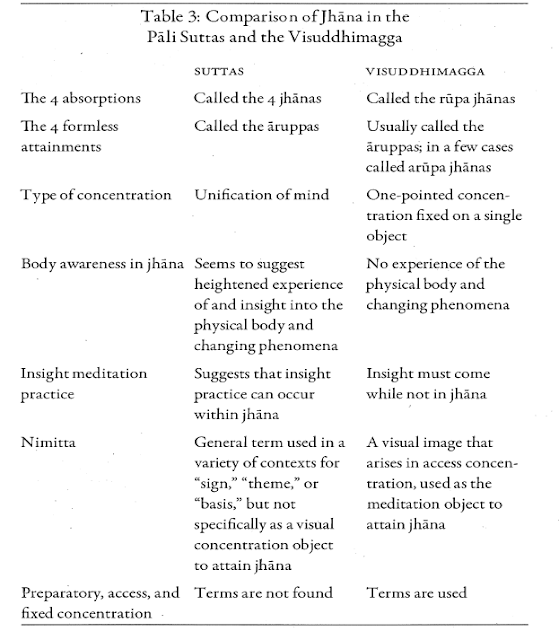
Jhana is clearly not required for any of the stages of enlightenment in the Visuddhimagga. The suttas are ambiguous about the necessity ofjhana for stream-entry, and the case becomes increasingly strong with each successive stage of enlightenment. The controversies over what is the “real” jhana resolve when we realize that there are two distinct jhanas in the Pali literature, each one true and correct within its own system: “sutta jhana” and “Visuddhimagga jhana.” These two jhana systems are not the same. They comprise different meditative states, sharing some features in common, but with their own unique characteristics, potentials, and methods for realizing them. Each can be properly understood only within the overall context of the texts within which, it appears.
(pagina 101-104)
====================================================================
Het hele boek van Shankman (236 pagina's) kan als pdf op verzoek bij mij verkregen worden, evenals het hele artikel van Garbe.
====================================================================
E . Openingsparagraaf uit de pdf: 'Samādhi '
(door) Christina Garbe
Samatha bhāvanā - Konzentrationsmeditation
Der gewöhnliche Geist ist abgelenkt und unkontrolliert. Buddhistische Meditation ist eine
Methode der geistigen Entwicklung, um den Geist zu beruhigen, zu reinigen, zu Erkenntnis
zu gelangen und Leiden endgültig zu überkommen, ein Weg der Befreiung. Um Befreiung
von Leiden, was bedeutet, von Problemen, Schwierigkeiten jeglicher Art, zu erreichen, ist
Meditation von grundlegender Bedeutung. Die Meditationsarten in der theravādabuddhistischen
Tradition basieren auf den eigenen Erfahrungen des letzten Buddha Gotama,
der vor ca. 2500 Jahren in Indien lebte und diesen Weg praktiziert hat. Es ist der Weg, um
vollkommene Erleuchtung zu erfahren.
In den überlieferten Schriften, im buddhistischen Pāḷikanon, werden zwei Arten von
Meditation beschrieben:
Samatha-bhāvanā, Ruhe- oder Konzentrationsmeditation und Vipassanā-bhāvanā,
Einsichtsmeditation.
Ruhe/Konzentrationsmeditation gibt es auch in anderen Religionen, Einsichtsmeditation gibt
es nur in der buddhistischen Lehre. Der Buddha hat am Anfang seines Meditationsweges
auch schon Konzentrationsmeditation bei zwei Lehrern praktiziert. Er hat sich damit auf
seiner Suche nach endgültiger Befreiung von jeglichem Leiden jedoch nicht zufrieden
gegeben. Er ist allein den Weg weiter gegangen und hat dann die Einsichtsmeditation
(vipassanā), basierend auf Konzentrationsmeditation, wiederentdeckt.
Für die Einsichtsmeditation gibt es zwei Zugänge, den über die geistigen Absorptionen
(Jhānā), entwickelt durch Konzentrationsmeditation, und den über die Entwicklung von
Konzentration durch Achtsamkeit auf verschiedene Objekte in Körper und Geist. Die erste
Annäherung, ist auch für die zweite, die Entwicklung der allgemeinen korrekten Achtsamkeit,
sehr förderlich. Gleichzeitig ist die allgemeine Achtsamkeit notwendig, um Konzentration
entsprechend der Samatha-Meditation zu entwickeln. Um Einsichtsmeditation zu praktizieren
mit dem Ziel des Erleuchtungsbewußtseins, muß man nicht die geistigen Absorptionen
(Jhānā) erreichen können. Es ist jedoch ein sehr viel komfortablerer und einfacherer Weg,
wenn man geschickt ist im Erreichen der Absorptionen (Jhānā). Auch die Einsichten sind
klarer und stabiler. Das erlangte Wissen aus direktem Sehen ist umfassender, je
umfassender das Wissen, je besser und einfacher kann man mit dem Dharma (der Lehre)
leben. Man könnte die Einsichtsmeditation mit dem Anschauen des Körpers im Spiegel
vergleichen. Der Spiegel ist dabei das Werkzeug, um sich anschauen zu können, wie in der
Meditation die Konzentration das Werkzeug ist. Wenn wir den Spiegel die ganze Zeit der
Betrachtung mit den Händen festhalten müssen, wird es sehr anstrengend und wir können
uns nicht von allen Seiten ungehindert betrachten. Hängen wir den Spiegel jedoch an einen
festen Haken an die Wand, können wir uns in Ruhe und von allen Seiten betrachten. So ist
es auch mit einer gut gefestigten Konzentration, je tiefer und stabiler die Konzentration, je
besser können wir das Dasein ohne Anstrengung von allen Seiten betrachten.
Einsichtsmeditation oder Achtsamkeitspraxis ohne ausreichende Konzentration bleibt
oberflächlich und führt nicht zur letztendlichen Befreiung vom Leiden. Durch Konzentration
entwickelt man einen gesammelten, friedlichen, ruhigen Geist als Voraussetzung für die
Entwicklung von Weisheit in der Einsichtsmeditation.
Die Samatha-Meditation allein birgt in sich dieselben Gefahren, wie alle existierenden
Phänomene, des Anhaftens und des Wunsches nach Existenz, nach besserer Existenz als
der, die man gerade lebt, jedoch als Grundlage für die Vipassanā-Meditation und das dann
aus Einsicht geführte spirituelle Leben, eine entschiedene Erleichterung. Samatha-
Meditation, erfolgreich praktiziert mit Zugangs- oder Jhānakonzentration, beruht auf sehr
heilsamen Geisteszuständen, die lange Zeit aufrechterhalten werden können und damit zu
einer sehr effektiven Reinigung des Geistes von Verunreinigungen führen. Sie ermöglichen
dem/der Meditierenden für lange Zeit im Hier und Jetzt ununterbrochen in glücklichen
Geisteszuständen zu verweilen. Diese glücklichen Geisteszustände sind eine ideale Basis für
tiefgründige Einsicht in die Natur aller Phänomene. Der Buddha hat in sehr vielen Lehrreden
seine Schüler dazu angewiesen, die geistigen Absorptionen (Jhānā) zu entwickeln und hat
ihnen die Voraussetzungen, ein ethisch reines Verhalten, dazu erklärt.
Ruhemeditation ist das geistige Training, um rechte Konzentration entsprechend dem edlen
achtfachen Pfad zu entwickeln. Im Mahāsatipaṭṭhāna Sutta (DN 22) der Lehrrede von den Grundlagen der Achtsamkeit, nennt der Buddha die Praxis der vier geistigen Absorptionen
(Jhānā) rechte Konzentration im Sinne des edlen achtfachen Pfades. Unser gewöhnliches
Denken, Reflektieren, Kontemplieren und Sehen geschieht auf konzeptueller Ebene, d. h. wir
sehen Frauen, Männer, Kinder, Autos, Kleider usw. und denken über diese Konzepte nach.
Die wirkliche Natur der Dinge kann nur durch das Sehen und Erfahren von ultimativen,
letztendlichen Realitäten (paramattho), die jenseits von Konzepten liegen, erkannt werden.
Für dieses Erkennen ist eine tiefe, anhaltende Konzentration, wie sie in der Samatha-
Meditation geübt wird, notwendig. Von dem Buddha wurden vierzig Objekte1 gegeben, die
sich für diese Ruhemeditation eignen. Man kann entsprechend des Charakters des
Meditierenden das entsprechende auswählen.
Konzentration bedeutet ‚zusammen zum Mittelpunkt‘, das heißt, daß das Bewußtsein und die
Geistesfaktoren gesammelt zum Mittelpunkt, zum Objekt der Betrachtung, gehen. Samādhi
setzt sich aus den drei Wörtern ‚sam‘ - zusammen, ‚ā‘ auf etwas zu, gegenüber, ‚dhā‘ halten,
tragen, zusammen. So kann man sagen, etwas zusammen zu etwas tragen oder halten. Der
Sinn ist derselbe, wie der des lateinischen Wortes Konzentration. Samādhi ist ein Zustand
tiefer geistiger und körperlicher Entspannung durch Einsgerichtetheit, das diskursive,
assoziierende Denken hört völlig auf. Der Geist geht völlig auf in dem Objekt der
Konzentration. Geist und Objekt werden eins. Der Geist ist in einem vollkommen klaren und
wachen Zustand. Dadurch findet eine tiefgehende Reinigung des Geistes statt, die
Vernebelung durch Verblendung wird gesäubert, so daß Weisheit entfaltet werden kann.
Der edle achtfache Pfad wurde vom Buddha gelehrt, um Leiden zu überwinden und
anhaltendes Glück zu erlangen. Das Training der Konzentration umfaßt drei Glieder des
edlen achtfachen Pfades, nämlich das Aufbringen von Energie für heilsame Geisteszustände,
eine sinnvoll ausgerichtete Achtsamkeit (sati), um die Natur der Dinge zu erkennen und eine
einsgerichtete, ungestörte Konzentration.
Die anderen beiden Trainings des edlen achtfachen Pfads sind Ethik, die man vor der
Konzentrationsübung praktizieren muß, und Weisheit, die aufbauend auf Konzentration
durch Einsichtsmeditation erlangt wird. Man kann die Ruhemeditation deshalb auch
Reinigung des Geistes nennen, weil sie Voraussetzung ist, um Weisheit zu entwickeln. Der
Geist wird durch Konzentration vorbereitet und in einen Zustand versetzt, um Weisheit zu
erlangen. Durch Konzentration entsteht ein Geisteszustand, welcher nicht dem gewöhnlichen
assoziativen Denken entspricht, sondern welcher die Dinge klar und unbeeinflußt durch die
Vergangenheit, aus dem gegenwärtigen Moment, sieht.
…..
Deze blogtekst hoort in een serie van de afgelopen en komende maanden.
Ze zijn – voor mezelf en misschien voor de lezers – een voorbereiding op het seminar/miniretraite in Amersfoort van 29 en 30 oktober te geven door Leigh Brasington
Zie de aankondiging en uitnodiging op de website van de SIM, www.simsara.nl
Er is nog een tiental plaatsen voor elk van beide dagen beschikbaar.
Zie voor eerdere teksten hier en hier .
In september en oktober wil ik nog meer teksten plaatsen, bv het interview met Leigh in het boek van Shankman en een samenvatting van een artikel van Quli (voor beide: zie onder)
Ook wil ik een (Nederlandse) samenvatting geven van een artikel van de bekende monnik-geleerde-meditatieleraar Henepola Gunaratana, met de uitdagende titel: Should we come out of Jhåna to practice Vipassanå ? Ik zal het antwoord vast verklappen: nee .
Dit keer een overzicht van interviews met Leigh, twee berichten en twee wat langere teksten.
==================================================================
A . Een paar interviews met Leigh en artikelen n.a.v. interviews
Als kennismaking met Leigh Brasington en zijn benadering van samatha meditatie en de jhana's, en als voorbereiding op het seminar/minitraite 29 en 30 oktober
Een Video Interview with Willoughby Britton of the Cheetah House
' Leigh Brasington on the Dark Night ' 7 Jan 2013 → Hier te beluisteren en bekijken '
' What are Jhanas ?' Een video-interview uit 2011, door Stephanie Nash, hier
' Practical Jhānas: Right Concentration and the Suttas ' door Leigh Brasington
Secular Buddhism Conference – Barre Center for Buddhist Studies 26 March, 2013
Zie hier
Een uitgebreid interview met Leigh in het boek 'The experience of Samadhi', door Richard Shankman, hieronder verder genoemd. Ik overweeg deze tekst in een volgende blog op te nemen of samen te vatten.
' Multiple Buddhist Modernisms: Jhāna in Convert Theravāda ' door Natalie Quli
Zie Quli-Jhana . Zoals hierboven aangekondigd, wil ik dit – deels op interviews gebaseerde - artikel in september samenvatten.
==================================================================
B . Nog een retraite over en met samatha (en vipassana)
Dan nog meer goed nieuws voor wie al langer vermoedt dat er meer is dan alleen vipassana-meditatie.
Naast de bijeenkomst met Brasington eind oktober is er ook – door de stichting Sanghametta – een retraite georganiseerd van 3 tot 24 september (kan ook deels) a.s. in Vught met de dhammalerares Christina Garbe. Over een paar weken al, dus snel nagaan of er nog plaats is.
Zie de aankondiging ervan:
“Best of both worlds
Het onderricht van Christina Garbe is een combinatie van concentratiemeditatie (samatha) en inzichtsmeditatie (vipassana), een samengaan van het beste van de Mahasi en de Pa Auk methode. Door deze combinatie van opmerkzaamheid/mindfulness en concentratie ontstaat een krachtige geest die zuiver wordt en tot diepere inzichten kan komen.
Opbouw retraite
We beginnen met anderhalve dag oefenen, theorie en uitwisseling om bekend te worden met de concentratiemeditatie. Vervolgens wordt de overige 19 dagen in stilte gemediteerd. ”
Ik heb dit voorjaar een korte retraite bij haar gedaan en zie een verschil tussen haar benadering (en van haar Burmese leraren) en die van Brasington als Ayya Khema –leerling. Deels, en in ieder geval volgens mij komt dit verschil neer op het werken met het Jhana-begrip uit de Sutta's en dat volgens de Visuddhimagga.
Over het verschil daartussen: zie onderstaande tekst van Richard Shankman. D.w.z. de eerste ervan; de tweede tekst is een interview van Shankman met Leigh Brasington, die m.i. De Sutta-lijn volgt.
Van Christina Garbe (die de retraite in het Engels geeft!) heb ik alleen een Duitse tekst beschikbaar over samadhi, aan het eind van deze blog citeer ik een deel daarvan.
==================================================================
C . Twee artikelen van Gerolf 't Hooft over Concentratie en Jhana in BoeddhaMagazine
Nog een bewijs voor de toenemende belangstelling voor de concentratie-meditatie (met name dan in de Theravada-gemeenschap) is een tweetal artikelen geschreven door Gerolf 't Hooft (oprichter van uitgever Asoka) in het tijdschrift BoeddhaMagazine in de eerste helft van 2013.
Zie de website Boeddhamagazine Online en website Uitgever
Bij beide artikelen – die ook online te raadplegen zijn – een paar opmerkingen. Verder: in hun geheel lezen!
' Concentratie (of het openen van de deur van de geest)' door Gerolf T'Hooft
Zie de link http://boeddhamagazine.nl/concentratie/
Dicht bij het vroege boeddhisme blijvend wordt een overzicht gegeven van de verschillende vormen (niveaus) van concentratie-meditatie; en bij de verhouding vipassana-samatha.
'Concentratie' omschrijft 't Hooft als: 'de strijd tegen hindernissen '.
De 'vijf factoren van concentratie ' (vitakka, vicara, piti, sukha, ekagatta) zijn een soort tegengif (een term die hij niet gebruikt) tegen de vijf respectievelijke hindernissen.
Of dat één-op-één klopt, weet ik niet zeker, ook vermoed ik dat Brasington vitakka en vicara niet vertaalt als 'initiële' c.q. 'aanhoudende gerichtheid' en of hij ekagatta (éénpuntigheid) als factor bij de eerste jhana beschouwt.
' Jhāna (of het afdalen in de diepten van de geest) ' door Gerolf T'Hooft
Zie de link http://boeddhamagazine.nl/jhana/
In dit tweede artikel gaat de auteur door op het bereiken van 'Jhana' als tevolg van concentratie-meditatie. Zeer verhelderend, ook terminonolgisch.
De vier jhana's worden steeds met één woord getypeerd:
'Verrukking' (eerste jhana);
'Vreugde' (tweede jhana);
'Rust' (derde jhana);
'Gelijkmoedigheid' (vierde jhana);
De afsluitende paragraaf heeft als kopje 'Inzicht '; ik citeer:
"Deze vier meditatiestadia zijn uiterst aangename ervaringen en het geluk dat ermee gepaard gaat overtreft alles wat we via de gebruikelijke zintuigen kunnen beleven. Het zijn en blijven echter geconditioneerde fenomenen. De jhāna’s hebben weliswaar de kracht om blijvend de illusie te doorbreken dat we voor ons geluk afhankelijk zijn van de buitenwereld, toch is er nog steeds de afhankelijkheid van concentratie. In combinatie met een retrospectieve analyse van de jhāna’s als veranderlijke verschijnselen (anicca) vormen ze volgens de Boeddha echter de noodzakelijke maar ideale springplank naar transformerend inzicht in de drie kenmerken van het persoonlijk bestaan: dukkha, anicca en anattā, de drie deuren naar bevrijding, de drie vensters op nibbāna. Alleen een geest die d.m.v. de jhāna’s is voorbereid, soepel, open en tevreden is, kan de sprong wagen naar een totaal ander soort inzicht. Een inzicht dat zo diep en onomkeerbaar ingrijpt in onze gebruikelijke manier van ervaren, dat we volgens de Boeddha vanaf dat moment feitelijk een ander soort mens worden ..."
==================================================================
D . Citaat hfst 4 van Shankman: Controversies Surrounding Samadhi
Belangrijk – met name in de Theravada-vipassana-gemeenschap is het verschijnen in 2008 geweest van het boek
'The Experience of SAMADHI
An In-depth Exploration of Buddhist Meditation
door Richard Shankman , zelf boeddhistisch meditatie-leraar.
In dit boek gaat hij na hoe 'Samadhi' en 'Jhana' in de Pali-teksten voorkomt, eerst in de Sutta's en vervolgens in de Visuddhimagga van Buddhagghosa (zie mijn blog van 14 juni hierover)
Hier neem ik een deel over van het hoofdstuk dat de (oude en nieuwe) controversen over deze begrippen beschrijft. In een volgende blog neem ik het interview op van Shankman met Brasington.
Chapter 4 - - - Controversies Surrounding Samadhi
Having released knots, a sage here in the world does not follow any faction when disputes arise.
Calmed among those who are not calm, equanimous, he does not take up opinions, saying “Let others take them up. ”
The Buddha, Sutta Nipata, 912
It is easy to see why there is a range of viewa about samadhi and the nature of jhana, and easy to understand why later commentators were eager to clarify the meaning of the Pali suttas according to their own understandings. Many of the meditative states and techniques for attaining them are described very concisely in the suttas, using compressed formulas with little or incomplete explanatory detail, and so are only partially adequate as practical meditation guides. Sutta passages often rely on standard prescribed phrases, which served to assist in memorization for their oral transmission in the early centuries before they were finally codified in written form. A few of them sketch out a full map for the practice, but none of them fill in all the details. Although perhaps the details would has been enough for a practitioner during the time when the suttas were composed, the - original meanings of some words, as intended within a sutta’s context, may not be clearly understood by modern Pali scholars (it is also quite possible that greater detail was provided orally, outside the formulaic pattern o f the suttas). There is reason to suspect that certain passages were inserted at later dates. Unless we want to pick and choose the portions of the suttas we are inclined to accept as original, leaving the rest, we must accept the suttas as they exist today. We can find either inconsistency or congruency amongthe wide range of practices in the canonical and commentarial texts, depending on our viewpoint.
There is disagreement about what jhana is, and the term is used to describe a range of experiences by various teachers. Jhana is always defined by the standard formula, in which the presence or absence of five jhana factors and other supplemental elements characterize the various levels ofjhana. Because these factors are present, to varying degrees, throughout a wide range oflevels and types of samadhi, various meditation teachers, each presenting a different idea ofwhatjhana is, can legitimately claim to be teaching the “real” jhana. There is no consensus onwhether or not jhana is necessary to realize the deeper stages ofinsight, and scriptural evidence can be found to support either view.
The scriptural sources can be conflicting. The Buddha of the early Pali suttas taught contextually, varying his advice depending on his audience and the immediate circumstances. The suttas, therefore, are not entirely consistent, presenting an array of styles and approaches to practice that vary to suit the range ofhuman temperaments, and lending themselves to various interpretations regarding the path of meditation.
Now that we have examined the range of ways samadhi and jhana are described in the suttas and the Visuddhimagga, some of the controversyand disagreement surrounding samadhi and how it is taught can be discussed.
The approach taken here is to remain open and receptive to reconciling the suttas and the Visuddhimagga, without having to do so, recognizing that there may be points of tension and incompatibility between the two. If the beginning premise is that the Visuddhimagga is the authority for understanding the suttas correctly, then the two sources must agree, and one
will be predisposed to interpret the suttas in light of the Visuddhimagga.
One will be disposed to construe the words and phrases of the suttas in the light of the explanations given by the Visuddhimagga. In the preceding chapters each has been viewed on its own terms, and they can now be compared in order to highlight their similarities and differences, convergences and inconsistencies. Various teachers and methods can then be surveyed without passingjudgment on their interpretations.
The debates surrounding samadhi can roughly be summarized by three broad questions:
(i ) What is jhana?
(2) Are concentration and insight two distinct paths of meditation practice or one?
(3) Is jhana necessary for insight?
The answers to all of these questions depend upon whether the Visuddhimagga is taken to be the authoritative interpretation of the suttas, and upon which interpretation of the suttas one adopts.
(pagina 77-79)
............
CONCLUSION
The Visuddhimagga presents a path of meditation and the states within it that is new and distinct from the Pali suttas. During the centuries between the composition of the suttas and Buddhaghosa’s great work, the understanding of jhana evolved from being a state of undistracted awareness and profound insight into the ' nature of changing phenomena to states of extreme
tranquillityin which the mind is utterly engrossed in the mental qualities of the jhana itself. Whether the path of meditation developed to adapt to that change or the new understanding arose from a change in the way meditation was practiced we cannot know. In any case, insight meditation and the path of concentration and tranquillity were necessarily separated because, in the fixed concentration of the Visuddhimagga, insight could arise onlyupon leaving jhana.
The basis for separatingmeditation into two paths and the controversy surrounding whether jhana is necessary at all for the deepest levels of awakening, is the notion that jhana is ancillary to insight meditation.Jhana may be developed, or not, prior to insight meditation, according to one’s own predispositions. In the Visuddhimagga, the entire reason for developing tranquillity is to attain jhana in order to then turn to other practices for cultivating insight.
The suttas, however, do not make such a clear distinction. The suttas never clearly articulate a dry path of pure insight in which jhana plays no role. One could separate insight meditation from samatha meditation, though both are part of the same path. The practice of right samadhi seems
to integrate tranquillity and insight into a single meditative path. Mindfulness meditation is a concentration practice leading toward jhana; insight meditation is not a separate practice. Although achieving tranquillity is not the ultimate goal of concentration meditation, the suttas regard tranquillity as important. Tranquillity is a supporting condition for insight to arise.
Tranquillity and insight are two inseparable facets of mental cultivation, mutually supportive and necessary. They can be cultivated independently, but ultimately must be brought together in a balanced way.
The two jhanas are equivalent in terms of the strength of concentration, but dissimilar in terms of the type of concentration. In both cases the mind has reached the peak of stillness.Jhana in the suttas is a state of heightened mindfulness and awareness of an ever-changing stream of experiences, in which the mind is unmoving. Jhana in the Visuddhimagga is a state of fixed concentration, where there is no experience of changing phenomena whatsoever, because the objects of the mind are unmoving.
The jhana factors vitakka-vicara, which can be understood in' the suttas in at least two possible ways, as applying and maintaining the mind on the object of meditation or as other mental activity, such as volition, thought, and mental evaluation, are strictly confined in meaning
in the Visuddhimagga to connecting and sustaining. Ekaggata, most properly understood in the suttas as unification of mind inclusive of all changing experiences, is a one-pointed, fixed concentration in the Visuddhimagga.
The prominent role of physical-body awareness in the sutta jhana definition, which is underscored in the jhana similes and the Mindfulness of the Body Sutta, is understood purely as the “mental” body in the Visuddhimagga.
The Visuddhimagga introduces several other concepts and terms that are not found in the suttas. Preparatory, access, and attainment concentration, as well as the signs (nimittas) accompanying these stages, are not found in the suttas. The word nimitta does appear in the suttas in connection with right concentration, but there it simply means “theme” or “basis” of concentration, and is equated with the four foundations of mindfulness. The forty meditation subjects can be found in the suttas, but many are only mentioned peripherally, often with little or no explanatory detail. There are certainly not the extensive and meticulous descriptions
found in the Visuddhimagga. In particular, kasil).a practice, which is central to the Visuddhimagga understanding ofjhana, is never explained in detail in the suttas at all.
The suttas and the Visuddhimagga are in agreement that a state of strong concentration totally divorced from any awareness of the body is not necessary for awakening. They differ simply in that the suttas do not define such a state as constituting the fourjhanas, whereas the Visuddhimagga does.

Jhana is clearly not required for any of the stages of enlightenment in the Visuddhimagga. The suttas are ambiguous about the necessity ofjhana for stream-entry, and the case becomes increasingly strong with each successive stage of enlightenment. The controversies over what is the “real” jhana resolve when we realize that there are two distinct jhanas in the Pali literature, each one true and correct within its own system: “sutta jhana” and “Visuddhimagga jhana.” These two jhana systems are not the same. They comprise different meditative states, sharing some features in common, but with their own unique characteristics, potentials, and methods for realizing them. Each can be properly understood only within the overall context of the texts within which, it appears.
(pagina 101-104)
====================================================================
Het hele boek van Shankman (236 pagina's) kan als pdf op verzoek bij mij verkregen worden, evenals het hele artikel van Garbe.
====================================================================
E . Openingsparagraaf uit de pdf: 'Samādhi '
(door) Christina Garbe
Samatha bhāvanā - Konzentrationsmeditation
Der gewöhnliche Geist ist abgelenkt und unkontrolliert. Buddhistische Meditation ist eine
Methode der geistigen Entwicklung, um den Geist zu beruhigen, zu reinigen, zu Erkenntnis
zu gelangen und Leiden endgültig zu überkommen, ein Weg der Befreiung. Um Befreiung
von Leiden, was bedeutet, von Problemen, Schwierigkeiten jeglicher Art, zu erreichen, ist
Meditation von grundlegender Bedeutung. Die Meditationsarten in der theravādabuddhistischen
Tradition basieren auf den eigenen Erfahrungen des letzten Buddha Gotama,
der vor ca. 2500 Jahren in Indien lebte und diesen Weg praktiziert hat. Es ist der Weg, um
vollkommene Erleuchtung zu erfahren.
In den überlieferten Schriften, im buddhistischen Pāḷikanon, werden zwei Arten von
Meditation beschrieben:
Samatha-bhāvanā, Ruhe- oder Konzentrationsmeditation und Vipassanā-bhāvanā,
Einsichtsmeditation.
Ruhe/Konzentrationsmeditation gibt es auch in anderen Religionen, Einsichtsmeditation gibt
es nur in der buddhistischen Lehre. Der Buddha hat am Anfang seines Meditationsweges
auch schon Konzentrationsmeditation bei zwei Lehrern praktiziert. Er hat sich damit auf
seiner Suche nach endgültiger Befreiung von jeglichem Leiden jedoch nicht zufrieden
gegeben. Er ist allein den Weg weiter gegangen und hat dann die Einsichtsmeditation
(vipassanā), basierend auf Konzentrationsmeditation, wiederentdeckt.
Für die Einsichtsmeditation gibt es zwei Zugänge, den über die geistigen Absorptionen
(Jhānā), entwickelt durch Konzentrationsmeditation, und den über die Entwicklung von
Konzentration durch Achtsamkeit auf verschiedene Objekte in Körper und Geist. Die erste
Annäherung, ist auch für die zweite, die Entwicklung der allgemeinen korrekten Achtsamkeit,
sehr förderlich. Gleichzeitig ist die allgemeine Achtsamkeit notwendig, um Konzentration
entsprechend der Samatha-Meditation zu entwickeln. Um Einsichtsmeditation zu praktizieren
mit dem Ziel des Erleuchtungsbewußtseins, muß man nicht die geistigen Absorptionen
(Jhānā) erreichen können. Es ist jedoch ein sehr viel komfortablerer und einfacherer Weg,
wenn man geschickt ist im Erreichen der Absorptionen (Jhānā). Auch die Einsichten sind
klarer und stabiler. Das erlangte Wissen aus direktem Sehen ist umfassender, je
umfassender das Wissen, je besser und einfacher kann man mit dem Dharma (der Lehre)
leben. Man könnte die Einsichtsmeditation mit dem Anschauen des Körpers im Spiegel
vergleichen. Der Spiegel ist dabei das Werkzeug, um sich anschauen zu können, wie in der
Meditation die Konzentration das Werkzeug ist. Wenn wir den Spiegel die ganze Zeit der
Betrachtung mit den Händen festhalten müssen, wird es sehr anstrengend und wir können
uns nicht von allen Seiten ungehindert betrachten. Hängen wir den Spiegel jedoch an einen
festen Haken an die Wand, können wir uns in Ruhe und von allen Seiten betrachten. So ist
es auch mit einer gut gefestigten Konzentration, je tiefer und stabiler die Konzentration, je
besser können wir das Dasein ohne Anstrengung von allen Seiten betrachten.
Einsichtsmeditation oder Achtsamkeitspraxis ohne ausreichende Konzentration bleibt
oberflächlich und führt nicht zur letztendlichen Befreiung vom Leiden. Durch Konzentration
entwickelt man einen gesammelten, friedlichen, ruhigen Geist als Voraussetzung für die
Entwicklung von Weisheit in der Einsichtsmeditation.
Die Samatha-Meditation allein birgt in sich dieselben Gefahren, wie alle existierenden
Phänomene, des Anhaftens und des Wunsches nach Existenz, nach besserer Existenz als
der, die man gerade lebt, jedoch als Grundlage für die Vipassanā-Meditation und das dann
aus Einsicht geführte spirituelle Leben, eine entschiedene Erleichterung. Samatha-
Meditation, erfolgreich praktiziert mit Zugangs- oder Jhānakonzentration, beruht auf sehr
heilsamen Geisteszuständen, die lange Zeit aufrechterhalten werden können und damit zu
einer sehr effektiven Reinigung des Geistes von Verunreinigungen führen. Sie ermöglichen
dem/der Meditierenden für lange Zeit im Hier und Jetzt ununterbrochen in glücklichen
Geisteszuständen zu verweilen. Diese glücklichen Geisteszustände sind eine ideale Basis für
tiefgründige Einsicht in die Natur aller Phänomene. Der Buddha hat in sehr vielen Lehrreden
seine Schüler dazu angewiesen, die geistigen Absorptionen (Jhānā) zu entwickeln und hat
ihnen die Voraussetzungen, ein ethisch reines Verhalten, dazu erklärt.
Ruhemeditation ist das geistige Training, um rechte Konzentration entsprechend dem edlen
achtfachen Pfad zu entwickeln. Im Mahāsatipaṭṭhāna Sutta (DN 22) der Lehrrede von den Grundlagen der Achtsamkeit, nennt der Buddha die Praxis der vier geistigen Absorptionen
(Jhānā) rechte Konzentration im Sinne des edlen achtfachen Pfades. Unser gewöhnliches
Denken, Reflektieren, Kontemplieren und Sehen geschieht auf konzeptueller Ebene, d. h. wir
sehen Frauen, Männer, Kinder, Autos, Kleider usw. und denken über diese Konzepte nach.
Die wirkliche Natur der Dinge kann nur durch das Sehen und Erfahren von ultimativen,
letztendlichen Realitäten (paramattho), die jenseits von Konzepten liegen, erkannt werden.
Für dieses Erkennen ist eine tiefe, anhaltende Konzentration, wie sie in der Samatha-
Meditation geübt wird, notwendig. Von dem Buddha wurden vierzig Objekte1 gegeben, die
sich für diese Ruhemeditation eignen. Man kann entsprechend des Charakters des
Meditierenden das entsprechende auswählen.
Konzentration bedeutet ‚zusammen zum Mittelpunkt‘, das heißt, daß das Bewußtsein und die
Geistesfaktoren gesammelt zum Mittelpunkt, zum Objekt der Betrachtung, gehen. Samādhi
setzt sich aus den drei Wörtern ‚sam‘ - zusammen, ‚ā‘ auf etwas zu, gegenüber, ‚dhā‘ halten,
tragen, zusammen. So kann man sagen, etwas zusammen zu etwas tragen oder halten. Der
Sinn ist derselbe, wie der des lateinischen Wortes Konzentration. Samādhi ist ein Zustand
tiefer geistiger und körperlicher Entspannung durch Einsgerichtetheit, das diskursive,
assoziierende Denken hört völlig auf. Der Geist geht völlig auf in dem Objekt der
Konzentration. Geist und Objekt werden eins. Der Geist ist in einem vollkommen klaren und
wachen Zustand. Dadurch findet eine tiefgehende Reinigung des Geistes statt, die
Vernebelung durch Verblendung wird gesäubert, so daß Weisheit entfaltet werden kann.
Der edle achtfache Pfad wurde vom Buddha gelehrt, um Leiden zu überwinden und
anhaltendes Glück zu erlangen. Das Training der Konzentration umfaßt drei Glieder des
edlen achtfachen Pfades, nämlich das Aufbringen von Energie für heilsame Geisteszustände,
eine sinnvoll ausgerichtete Achtsamkeit (sati), um die Natur der Dinge zu erkennen und eine
einsgerichtete, ungestörte Konzentration.
Die anderen beiden Trainings des edlen achtfachen Pfads sind Ethik, die man vor der
Konzentrationsübung praktizieren muß, und Weisheit, die aufbauend auf Konzentration
durch Einsichtsmeditation erlangt wird. Man kann die Ruhemeditation deshalb auch
Reinigung des Geistes nennen, weil sie Voraussetzung ist, um Weisheit zu entwickeln. Der
Geist wird durch Konzentration vorbereitet und in einen Zustand versetzt, um Weisheit zu
erlangen. Durch Konzentration entsteht ein Geisteszustand, welcher nicht dem gewöhnlichen
assoziativen Denken entspricht, sondern welcher die Dinge klar und unbeeinflußt durch die
Vergangenheit, aus dem gegenwärtigen Moment, sieht.
…..
vrijdag 14 juni 2013
De onontkoombare VisuddhiMagga (voor welke Theravadin dan ook)
Vooraf: delen van deze tekst horen in een serie ten behoeve van het door Leigh Brasington gegeven seminar op 29 en 30 oktober over concentratie-meditatie. Als eerste hiervan m'n aankondiging en uitnodiging van 10 mei j.l.
Het seminar is op dit moment ongeveer voor de helft volgeboekt. Zie ook de informatie op de SIM-website .
Al veel jaren neem ik met enige regelmaat de ' VisuddhiMagga ' ter hand, eerst als boek uit de U.B. en later overdrachtelijk in de electronische versie. En leg het na het lezen van een paar flarden weer weg. Denkend: een encyclopedie lees je ook niet van band tot band.
'Path of Purification ' (het Pad van de Zuivering, of 'Zuiveringen') is de vertaling, uit het Pali in het Engels door Bhikkhu Nanamoli www.accesstoinsight.org/lib/authors/nanamoli/PathofPurification2011.pdf
De eerste druk is uit 1956.
Deze vertaling telt ruim 800 pagina's; alleen al de inhoudsopgave van 14 pagina's is lastig te doorgronden (de korte versie ervan is bijlage 3 hieronder).
Dit boek van de uit India afkomstige monnik Buddhaghosa , geschreven in Sri Lanka in de 5e eeuw van onze jaartelling kreeg als ondertitel (van de vertaler):
' The Classic Manual of Buddhist Doctrine and Meditation '; en zo is het.
Geen pretje om te lezen of om in te bladeren. Maar toch: het is onontkoombaar voor wie zich maar een beetje (zoals ik) Theravadin voelt. Geen bladzij van de vertalingen van Sutta's (die van Bhikkhu Bodhi en volgens mij ook van de Breet en Janssen) of er wordt wel verwezen naar de VM of naar andere 'kommentaren' van Buddhaghosa die in zekere zin een uitwerking van de VM zijn.
De gecompliceerde structuur van het boek kan deels worden verklaard doordat het een stapeling van indelingen bevat. De meest algemene is die in
- sila (virtue, ethische regels : chapter I en II),
- samadhi (concentration, concentratie : chapter III t/m XIII) en
- panna (understanding, wijsheid : chapter XIV t/m XXIII). In dit laatste deel komen ook de (zeven) zuiveringen aan de orde.
Toch is het niet de complexe structuur van het boek die mij vaak ergerde; dat is meer (naast de pedante stijl en soms rare logica) dat hiermee de Theravada, duizend jaar na het leven van de Boeddha, definitief een systeem, een orthodoxie, is geworden.
De VisuddhiMagga is de voltooiing van de Theravada-scholastiek , daarna zijn er alleen nog details uitgewerkt. Een systeem waar ik behoorlijk wat vertrouwen in heb maar dat ik hier en daar persé niet volg en dat af en toe knelt.
Ik blijf de voorkeur geven aan de rommelige Sutta's zelf, iets neutraler genoemd 'het vroege boeddhisme'.
Opvallend is dat deze Engelse uitgave ook een 'Message', uit 2000, bevat van de Dalai Lama , nog een 'bewijs' van de betekenis die in brede kring onder boeddhisten aan dit werk wordt gegeven. Ik heb deze boodschap in bijlage 1 opgenomen.
Geen meditatiemethode of het komt er wel in aan de orde.
Eerlijk gezegd de vipassana volgens de Mahasi methode nog het minst (wel de resultaten in de vorm van 'inzichten' die er mee te bereiken zijn, maar niet de methode).
[UPDATE van 17 juni: ook een belangrijk facet van deze vipassana-methode wordt één keer genoemd, namelijk dat van 'momentary concentration" ,voor mij onduidelijk in welk verband; ook nog een paar keer in voetnoten maar die zijn van de vertaler.]
Over de metta-meditatie en verdere Brahmavihara's gaat hoofdstuk IX (pagina 291 e.v.in het boek, pagina 350 e.v. in de pdf) In feite baseren alle hedendaagse instructies over metta-meditatie zich nog steeds op deze tekst (en op de Metta Sutta).
Datzelfde geldt voor de contemplaties op de dood hoofdtuk VIII, par.7: Mindfulness of death (pag 225-236 in het boek en pag 283-294 in de pdf).
Een groot deel van het boek gaat over samadhi (concentratie ): over de jhana's en hoe die te bereiken, zie hieronder.
De uitsdrukking 'en nog veel meer' is in zeer sterke mate op dit boek van toepassing; in deze blog heb ik nog maar een fractie van de inhoud benoemd.
En een groot deel is nog steeds relevant, ook voor wie het niet met alles eens is.
Als Jan de Breet en Rob Janssen in 2014 de vertaling van de Samyutta Nikaya hebben voltooid en ze niet (meteen) met de vertaling van de Anguttara Nikaya willen beginnen, is de VM wellicht een uitdaging voor hen en voor hun uitgever.
======================================================
Drie voorbeelden van de rijkdom van de VisuddhiMagga :
======================================================
De eerste betreft de concentratie-meditatie (samatha)
In feite gaat heel Part II (pagina 81-430) er over, alleen de laatste twee hoofdstukken van dit deel – over de bovennatuurlijke effecten – negeer ik liever.
Ik citeer uit Sleutel tot inzicht ; een deel van de Pali-woorden weglatend:
"Vis. 3-6 geeft volledige aanwijzingen over hoe volledige concentratie en de meditatieve verdiepingen (jhana's) verkregen kunnen worden door middel van de volgende 40 meditatieonderwerpen:
* 10 kasina-oefeningen. Deze brengen de 4 verdiepingen (jhana's) voort.
De 10 kasina's die in de sutta's worden bedoeld, zijn: het aarde-kasina; het water-kasina; het vuur-kasina; het wind-kasina; het blauw-kasina; het geel-kasina; het rood-kasina; het wit-kasina; het ruimte-kasina; en het bewustzijn-kasina.
* 10 walgelijke onderwerpen. Deze brengen de 1e verdieping voort.
* 10 herinneringen aan: de Boeddha; de Leer; de boeddhistische gemeenschap (sanghanussati); moraliteit; vrijheid; de hemelse wezens; de dood (maranasati); het lichaam; de in- en uitademing (anapana sati) en vrede.
Onder deze, kan de bespiegeling (of indachtigheid) van de in- en uitademing, alle 4 de meditatieve verdiepingen voortbrengen: die van het lichaam de 1e verdieping, en de rest alleen nabijheid-concentratie (upacara samadhi).
* 4 verheven verblijven (brahma vihara): liefdevolle vriendelijkheid (metta), mededogen (karuna), sympathische vreugde (mudita) en gelijkmoedigheid (upekkha). Van deze, brengen alleen de eerste 3 oefeningen, 3 verdiepingen voort; de laatste (gelijkmoedigheid) alleen de 4e verdieping (jhana).
* 4 onstoffelijke sferen van: onbegrensde ruimte, onbegrensd bewustzijn, niets-heid en noch waarnemen noch niet waarnemen. Deze hebben betrekking op de 4e meditatieve verdieping, want de 4 verdiepingen van de onstoffelijke sfeer, behoren, strikt gesproken, nog steeds tot de 4e jhana, omdat zij dezelfde twee factoren bevatten.
* 1 aanschouwing van de walgelijkheid van voedsel, wat nabijheid-concentratie kan voortbrengen.
* 1 analyse van de 4 elementen, wat eveneens nabijheid-concentratie kan voortbrengen."
Een aantal van deze fenomenen worden nog steeds als meditatie-object gebruikt, de 'walgelijke' onderwerpen waarschijnlijk alleen door monniken.
In een 'Sangha Metta' retraite afgelopen voorjaar met Christina Garbe (en Jotika Hermsen) werd bijvoorbeeld gebruik gemaakt van de anapanasati, de metta, de vier elementen en een aantal kleur-kasina's (in de vorm van cirkels) als meditatie-object ten behoeve van het bereiken van de (eerste) jhana.
Leigh Brasington zal het in oktober vermoedelijk vooral hebben over de anapanasati
======================================================
Als tweede voorbeeld een opsomming in hoofdstuk IV (dat gaat over The Earth Kasina) van de 'achttien fouten van een klooster', de negatieve formulering van de eisen waaraan een klooster moet voldoen:
[THE EIGHTEEN FAULTS OF A MONASTERY]
Herein, one that is unfavourable has anyone of eighteen faults. These are:
( 1) GROOT (largeness),
( 2) NIEUW (newness),
( 3) BOUWVALLIG (dilapidatedness),
( 4) NABIJ EEN WEG (a nearby road),
( 5) VIJVER (a pond),
( 6) EETBARE BLADEREN ([edible] leaves),
( 7) BLOEMEN (flowers),
( 8) VRUCHTEN (fruits),
( 9) BEROEMD (famousness),
(10) NABIJ EEN STAD (a nearby city),
(11) NABIJ KAPBAAR BOS (nearby timber trees),
(12) NABIJ BEBOUWBAAR LAND (nearby arable fields),
(13) AANWEZIGHEID VAN ONVERENIGBARE MENSEN (presence of incompatible persons),
(14) NABIJ EEN HAVEN OF TOEGANGSWEG (a nearby port of entry),
(15) NABIJ GRENZEN TUSSEN LANDEN (nearness to the border countries),
(16) NABIJ DE GRENS VAN EEN KONINKRIJK (nearness to the frontier of a kingdom),
(17) ONGESCHIKTHEID (unsuitability),
(18) ONTBREKEN VAN GOEDE (SPIRITUELE) VRIENDEN (lack of good friends).
One with any of these faults is not favourable. He should not live there.
(Pagina 113 in de nummering van het boek, en 171 in de pdf )
Waarom deze 18 omstandigheden onwenselijk zijn (voor een monnik) om naar een bepaald klooster te gaan wordt in dit toch spiritueel veronderstelde boek door Buddhaghosa zeer konkreet beschreven. Zie bijlage 2
Wellicht kunnen de initiatiefnemers van het te starten Vipassana Meditatie- en StudieCentrum (ergens in Nederland) er gebruik van maken. Zie de nieuwe website van dit centrum (in oprichting)
Hoewel: een groot deel van deze 'fouten' in de ogen van Buddhaghosa is dat er vrouwen zijn of op af kunnen komen; de andere sexe, die de monniken afleiden. Ik laat me er liever niet over uit of dit (of het omgekeerde: de gevaarlijke aanwezigheid van mannen) in Nederland ook speelt vanwege het gevaar als sexist aangeduid te worden.
======================================================
Het derde voorbeeld is de wijze waarop het leerstuk (of: de causale theorie) van de paticca samuppada (dependent origination, afhankelijk ontstaan) een plaats heeft gekregen in het Theravada-systeem.
Op zich komt dit model van twaalf ketenen in alle boeddhistische tradities voor, hoewel de plaats ervan, de visualisatie (prachtige of gruwelijke plaatjes) en de betekenis als causaliteit verschillen.
In het Mahayana-boeddhisme wordt (in het Sanskriet) van 'Pratītyasamutpāda gesproken ', een woord met nogal diverse Engelse vertalingen; bijvoorbeeld soms als 'interdependent co-arising ', m.i. een onjuiste want holistische verschuiving van de betekenis.
Bij de Theravada is kenmerkend dat het gekoppeld is aan de reincarnatie, en wel op een zeer specifieke wijze, genoemd het 'drie levens model '.
Zie 'CH. XVII THE SOIL OF UNDERSTANDING—CONCLUSION: DEPENDENT ORIGINATION'
Pagina 533-608 in het boek en pagina 591-666 van de pdf.
En met name daarvan 'Section C THE WHEEL OF BECOMING ', pagina 598 e.v. c.q. 656 e.v.
Dit model komt niet voor in de Sutta's waarvan (in de Theravada) aangenomen wordt dat ze zo'n 2500 jaar geleden door de Boeddha zijn uitgesproken (waar wel iets op valt af te dingen).
Wel komt in de Sutta's de leer van het afhankelijk ontstaan voor, soms worden een paar schakels genoemd dan weer in een andere Sutta een paar andere schakels, en opgeteld kan men tot twaalf komen.
Ook de reincarnatie, of we het leuk vinden of niet (ik vind het niet leuk) komt daar als feit aan de orde.
Maar de koppeling daartussen en de hechtheid daarvan, is het werk van latere scholastici en is in de VM definitief DE LEER gemaakt.
Ik zie er van af deze verandering in de betekenis van paticca sammupada te beschrijven, ook omdat Buddhadasa Bhikkhu het oneindig veel beter heeft gedaan, zie zijn Practical Dependent Origination
En omdat het duidelijk is verwoord door Leigh Brasington (de leraar die eind oktober naar Nederland komt) in zijn essay ' Dependent Origination: The 3 Lives Model: NOT ! ' Ik zou haast zeggen: dit is verplichte kost.
======================================================
Bijlage 1
MESSAGE FROM HIS HOLINESS THE DALAI LAMA
The history of the development of Buddhist literature seems to be marked by periods
in which the received teachings and established scriptures are assimilated and
consolidated and periods of mature creativity when the essence of that transmission
is expressed afresh. Bhadantácariya Buddhaghosa’s Visuddhimagga is a classic
text of the latter type. It represents the epitome of Pali Buddhist literature, weaving
together its many strands to create this wonderful meditation manual, which even
today retains the clarity it revealed when it was written.
There are occasions when people like to make much of the supposed differences
in the various traditions of Buddhism that have evolved in different times and places.
What I find especially encouraging about a book such as this is that it shows so
clearly how much all schools of Buddhism have fundamentally in common. Within
a structure based on the traditional three trainings of ethical discipline, concentration
and wisdom are detailed instructions on how to take an ethical approach to life,
how to meditate and calm the mind, and on the basis of those how to develop a
correct understanding of reality. We find practical advice about creating an
appropriate environment for meditation, the importance of developing love and
compassion, and discussion of dependent origination that underlies the Buddhist
view of reality. The very title of the work, the Path of Purification, refers to the essential
Buddhist understanding of the basic nature of the mind as clear and aware,
unobstructed by disturbing emotions. This quality is possessed by all sentient beings
which all may realize if we pursue such a path.
Sometimes I am asked whether Buddhism is suitable for Westerners or not. I
believe that the essence of all religions deals with basic human problems and
Buddhism is no exception. As long as we continue to experience the basic human
sufferings of birth, disease, old age, and death, there is no question of whether it
is suitable or not as a remedy. Inner peace is the key. In that state of mind you can
face difficulties with calm and reason. The teachings of love, kindness and
tolerance, the conduct of non-violence, and especially the Buddhist theory that
all things are relative can be a source of that inner peace.
While the essence of Buddhism does not change, superficial cultural aspects
will change. But how they will change in a particular place, we cannot say. This
evolves over time. When Buddhism first came from India to countries like Sri Lanka
or Tibet, it gradually evolved, and in time a unique tradition arose. This is also
happening in the West, and gradually Buddhism may evolve with Western culture.
Of course, what distinguishes the contemporary situation from past
transmissions of Buddhism is that almost the entire array of traditions that
evolved elsewhere is now accessible to anyone who is interested. And it is in
such a context that I welcome this new edition of Bhikkhu Ñáóamoli’s celebrated
English translation of the Path of Purification. I offer my prayers that readers,
wherever they are, may find in it advice and inspiration to develop that inner
peace that will contribute to creating a happier and more peaceful world.
May 2000
(Bron: Pagina 25 van de pdf)
======================================================
Bijlage 2
Waarom niet in een klooster met een van de 18 fouten verblijven?
CHAPTER IV
THE EARTH KASINA
1. [118] Now, it was said earlier: After that he should avoid a monastery
unfavourable to the development of concentration and go to live in one that is
favourable (III.28). In the first place one who finds it convenient to live with the
teacher in the same monastery can live there while he is making certain of the
meditation subject. If it is inconvenient there, he can live in another monastery—
a suitable one—a quarter or a half or even a whole league distant. In that case,
when he finds he is in doubt about, or has forgotten, some passage in the
meditation subject, then he should do the duties in the monastery in good time
and set out afterwards, going for alms on the way and arriving at the teacher’s
dwelling place after his meal. He should make certain about the meditation
subject that day in the teacher’s presence. Next day, after paying homage to the
teacher, he should go for alms on his way back and so he can return to his own
dwelling place without fatigue. But one who finds no convenient place within
even a league should clarify all difficulties about the meditation subject and
make quite sure it has been properly attended to. Then he can even go far away
and, avoiding a monastery unfavourable to development of concentration, live in
one that is favourable.
[ THE EIGHTEEN FAULTS OF A MONASTERY]
2. Herein, one that is unfavourable has anyone of eighteen faults. These are: (1)
largeness, (2) newness, (3) dilapidatedness, (4) a nearby road, (5) a pond, (6)
[edible] leaves, (7) flowers, (8) fruits, (9) famousness, (10) a nearby city, (11) nearby
timber trees, (12) nearby arable fields, (13) presence of incompatible persons, (14)
a nearby port of entry, (15) nearness to the border countries, (16) nearness to the
frontier of a kingdom, (17) unsuitability, (18) lack of good friends. [119] One with
any of these faults is not favourable. He should not live there. Why?
1. Firstly, people with varying aims collect in a large monastery. They conflict
with each other and so neglect the duties. The Enlightenment-tree terrace, etc.,
remain unswept, the water for drinking and washing is not set out. So if he
thinks, “I shall go to the alms-resort village for alms” and takes his bowl and
robe and sets out, perhaps he sees that the duties have not been done or that a
drinking-water pot is empty, and so the duty has to be done by him unexpectedly.
Drinking water must be maintained. By not doing it he would commit a
wrongdoing in the breach of a duty. But if he does it, he loses time. He arrives too
late at the village and gets nothing because the alms giving is finished. Also,
when he goes into retreat, he is distracted by the loud noises of novices and
young bhikkhus, and by acts of the Community [being carried out]. However, he
can live in a large monastery where all the duties are done and where there are
none of the other disturbances.
2. In a new monastery there is much new building activity. People criticize
someone who takes no part in it. But he can live in such a monastery where the
bhikkhus say, “Let the venerable one do the ascetic’s duties as much as he likes.
We shall see to the building work.”
3. In a dilapidated monastery there is much that needs repair. People criticize
someone who does not see about the repairing of at least his own lodging.
When he sees to the repairs, his meditation subject suffers.
4. In a monastery with a nearby road, by a main street, visitors keep arriving
night and day. He has to give up his own lodging to those who come late, and he
has to go and live at the root of a tree or on top of a rock. And next day it is the
same. So there is no opportunity [to practice] his meditation subject. But he can
live in one where there is no such disturbance by visitors.
5. A pond is a rock pool. Numbers of people come there for drinking water.
Pupils of city-dwelling elders supported by the royal family come to do dyeing
work. When they ask for vessels, wood, tubs, etc., they must be shown
where these things are. So he is kept all the time on the alert.
6. If he goes with his meditation subject to sit by day where there are many
sorts of edible leaves, then women vegetable-gatherers, singing as they pick leaves
nearby, endanger his meditation subject by disturbing it with sounds of the opposite sex.
7. And where there are many sorts of flowering shrubs in bloom there is the same danger too.
8. Where there are many sorts of fruits such as mangoes, rose-apples and
jak-fruits, people who want fruits come and ask for them, and they get angry if
he does not give them any, or they take them by force. When walking in the
monastery in the evening he sees them and asks, “Why do you do so, lay
followers?” they abuse him as they please and even try to evict him.
9. When he lives in a monastery that is famous and renowned in the world,
like Dakkhióagiri1 Hatthikucchi, Cetiyagiri or Cittalapabbata, there are always
people coming who want to pay homage to him, supposing that he is an Arahant,
which inconveniences him. But if it suits him, he can live there at night and go
elsewhere by day.
10. In one with a nearby city objects of the opposite sex come into focus.
Women-pot carriers go by bumping into him with their jars and giving no room
to pass. Also important people spread out carpets in the middle of the monastery
and sit down.
11. One with nearby timber trees where there are timber trees and osiers
useful for making framework is inconvenient because of the wood-gatherers
there, like the gatherers of branches and fruits already mentioned. If there are
trees in a monastery, people come and cut them down to build houses with.
When he has come out of his meditation room in the evening and is walking up
and down in the monastery, if he sees them and asks, “Why do you do so, lay
followers?” they abuse him as they please and even try to evict him.
12. People make use of one with nearby arable fields, quite surrounded by
fields. They make a threshing floor in the middle of the monastery itself. They
thresh corn there, dry it in the forecourts,2 and cause great inconvenience. And
where there is extensive property belonging to the Community, the monastery
attendants impound cattle belonging to families and deny the water supply [to
their crops]. Then people bring an ear of paddy and show it to the
Community saying “Look at your monastery attendants’ work.” For one reason
or another he has to go to the portals of the king or the king’s ministers. This
[matter of property belonging to the Community] is included by [a monastery
that is] near arable fields.
13. Presence of incompatible persons: where there are bhikkhus living who
are incompatible and mutually hostile, when they clash and it is protested,
“Venerable sirs, do not do so,” they exclaim, “We no longer count now that this
refuse-rag wearer has come.”
14. One with a nearby water port of entry or land port of entry3 is made
inconvenient by people constantly arriving respectively by ship or by caravan
and crowding round, asking for space or for drinking water or salt.
15. In the case of one near the border countries, people have no trust in the
Buddha, etc., there.
16. In one near the frontier of a kingdom there is fear of kings. For perhaps one
king attacks that place, thinking, “It does not submit to my rule,” and the other
does likewise, thinking, “It does not submit to my rule.” A bhikkhu lives there
when it is conquered by one king and when it is conquered by the other. Then
they suspect him of spying, and they bring about his undoing.
17. Unsuitability is that due to the risk of encountering visible data, etc., of
the opposite sex as objects or to haunting by non-human beings. Here is a story.
An elder lived in a forest, it seems. Then an ogress stood in the door of his leaf
hut and sang. The elder came out and stood in the door. She went to the end of
the walk and sang. The elder went to the end of the walk. She stood in a chasm
a hundred fathoms deep and sang. The elder recoiled. Then she suddenly
grabbed him saying, “Venerable sir, it is not just one or two of the likes of you I have eaten.”
18. Lack of good friends: where it is not possible to find a good friend as a
teacher or the equivalent of a teacher or a preceptor or the equivalent of a preceptor,
the lack of good friends there is a serious fault.
One that has any of those eighteen faults should be understood as
unfavourable. And this is said in the commentaries:
A large abode, a new abode,
One tumbling down, one near a road,
One with a pond, or leaves, or flowers,
Or fruits, or one that people seek; [122]
In cities, among timber, fields,
Where people quarrel, in a port,
In border lands, on frontiers,
Unsuitableness, and no good friend—
These are the eighteen instances
A wise man needs to recognize
And give them full as wide a berth
As any footpad-hunted road.
(Pagina 113-116 in de nummering van het boek, en 171-174 in de pdf)
======================================================
Bijlage 3
CONTENTS
(GENERAL)
Bibliography ................................................................................................................. xix
Printed Editions of the Visuddhimagga ..................................................................... xix
List of Abbreviations for Texts Used .......................................................................... xxi
Message from his Holiness the Dalai Lama ............................................................. xxiii
Publisher’s Foreword to Third Edition .................................................................... xxiv
Publisher’s Foreword to Fourth Edition ................................................................... xxiv
Translator’s Preface ..................................................................................................... xxv
INTRODUCTION .............................................................................................................. XXVII
THE PATH OF PURIFICATION
Part I—Virtue (Sìla)
CH.I DESCRIPTION OF VIRTUE ................................................................................... 5
[I. Introductory] ............................................................................................ 5
[II. Virtue] .................................................................................................... 10
CH. II THE ASCETIC PRACTICES ................................................................................ 55
Part II—Concentration (Samádhi)
CH. III TAKING A MEDITATION SUBJECT .................................................................... 81
[A. Development in Brief] ......................................................................... 86
[B. Development in Detail] ....................................................................... 87
[The Ten Impediments] ............................................................................ 87
CH. IV THE EARTH KASIÓA ..................................................................................... 113
[The Eighteen Faults of a Monastery] ................................................. 113
[The Five Factors of the Resting Place] ................................................ 116
[The Lesser Impediments] ..................................................................... 116
[Detailed Instructions for Development] ............................................ 117
[The Earth Kasióa]................................................................................... 117
[Making an Earth Kasióa] ..................................................................... 118
[Starting Contemplation] ....................................................................... 119
[The Counterpart Sign] .......................................................................... 120
[The Two Kinds of Concentration] ....................................................... 121
[Guarding the Sign] ................................................................................ 122
[The Ten Kinds of Skill in Absorption] ............................................... 124
[The Five Similes] ..................................................................................... 130
[Absorption in the Cognitive Series] ................................................... 131
[The First Jhána] ...................................................................................... 133
[Extension of the Sign] ........................................................................... 145
[The Second Jhána] ................................................................................. 148
[The Third Jhána] .................................................................................... 151
[The Fourth Jhána] .................................................................................. 156
[The Fivefold Reckoning of Jhána] ....................................................... 160
CH. V THE REMAINING KASIÓAS ...................................................................................... 162
[The Water Kasióa]....................................................................................... 162
[The Fire Kasióa] ...................................................................................... 163
[The Air Kasióa] ...................................................................................... 163
[The Blue Kasióa] ...................................................................................... 164
[The Yellow Kasióa] ...................................................................................... 164
[The Red Kasióa] ...................................................................................... 165
[The White Kasióa] ...................................................................................... 165
[The Light Kasióa]....................................................................................... 165
[The Limited-Space Kasióa] ................................................................... 166
[General] .................................................................................................... 166
CH. VI FOULNESS AS A MEDITATION SUBJECT .......................................................... 169
[General Definitions] .............................................................................. 169
[The Bloated]............................................................................................. 170
[The Livid] ................................................................................................ 179
[The Festering] ......................................................................................... 179
[The Cut Up] ............................................................................................. 179
[The Gnawed] ........................................................................................... 180
[The Scattered] .......................................................................................... 180
[The Hacked and Scattered] .................................................................. 180
[The Bleeding] .......................................................................................... 180
[The Worm-Infested] ................................................................................ 180
[A Skeleton] .............................................................................................. 180
[General] ................................................................................................... 182
CH. VII SIX RECOLLECTIONS ..................................................................................... 186
[(1) Recollection of the Enlightened One] .......................................... 188
[Accomplished] ................................................................................ 188
[Fully Enlightened] ......................................................................... 192
[Endowed With Clear Vision and Virtuous Conduct] ................. 193
[Sublime] ............................................................................................ 196
[Knower of Worlds] .......................................................................... 198
[Incomparable Leader of Men to be Tamed] ............................... 202
[Teacher of Gods and Men] ........................................................... 203
[Enlightened] .................................................................................... 204
[Blessed]............................................................................................. 204
[(2) Recollection of the Dhamma] ........................................................ 209
[Well Proclaimed] ............................................................................. 210
[Visible Here and Now] .................................................................. 212
[Not Delayed] .................................................................................... 213
[Inviting of Inspection] ................................................................... 213
[Onward-Leading] ........................................................................... 214
[Is Directly Experienceable by the Wise] ..................................... 214
[(3) Recollection of the Saògha] ........................................................... 215
[Entered on the Good, Straight, True, Proper Way] ................... 215
[Fit for Gifts] ...................................................................................... 216
[Fit for Hospitality] .......................................................................... 217
[Fit for Offering] ............................................................................... 217
[Fit for Salutation] ............................................................................ 217
[As an Incomparable Field of Merit for the World] ................... 217
[(4) Recollection of Virtue] .................................................................... 218
[(5) Recollection of Generosity] ............................................................ 220
[(6) Recollection of Deities] ................................................................... 221
[General] ............................................................................................ 222
CH. VIII OTHER RECOLLECTIONS AS MEDITATION SUBJECTS ...................................... 225
[(7) Mindfulness of Death] .................................................................... 225
[(8) Mindfulness Occupied with the Body] ....................................... 236
[(9) Mindfulness of Breathing] ............................................................. 259
[(10)Recollection of Peace] ..................................................................... 286
CH. IX THE DIVINE ABIDINGS .................................................................................. 291
[(1) Loving-Kindness] ............................................................................ 291
[(2) Compassion] ..................................................................................... 308
[(3) Gladness] .......................................................................................... 309
[(4) Equanimity] ...................................................................................... 310
CH. X THE IMMATERIAL STATES ............................................................................ 321
[(1) The Base Consisting of Boundless Space] .................................. 321
[(2) The Base Consisting of Boundless Consciousness] ................. 326
[(3) The Base Consisting of Nothingness] ......................................... 328
[(4) The Base Consisting of Neither Perception nor Non-Perception] 330
[General] ............................................................................................ 333
CH. XI CONCENTRATION—CONCLUSION:
NUTRIMENT AND THE ELEMENTS ................................................................. 337
[Perception of Repulsiveness in Nutriment] ...................................... 337
[Defining of The Elements: Word Definitions] .................................. 344
[Texts and Commentary in Brief] ......................................................... 345
[In Detail] .................................................................................................. 346
[Method of Development in Brief] ........................................................ 348
[Method of Development in Detail] ..................................................... 349
[(1) With Constituents in Brief] ..................................................... 349
[(2) With Constituents by Analysis] ............................................ 349
[(3) With Characteristics in Brief] ................................................. 357
[(4) With Characteristics by Analysis] ........................................ 358
[Additional Ways of Giving Attention] ............................................... 358
[Development of Concentration—Conclusion] ................................. 367
[The Benefits of Developing Concentration] ...................................... 367
CH. XII THE SUPERNORMAL POWERS ........................................................................ 369
[The Benefits of Concentration (Continued)] ..................................... 369
[(1) The Kinds of Supernormal Power] ......................................... 369
CH. XIII OTHER DIRECT-KNOWLEDGES ....................................................................... 400
[(2) The Divine Ear Element].......................................................... 400
[(3) Penetration of Minds]............................................................... 402
[(4) Recollection of Past Lives] ....................................................... 404
[(5) The Divine Eye—Knowledge of Passing Away and
Reappearance of Beings] ............................................................. 415
[General] ............................................................................................ 421
Part III—Understanding (Paññá)
CH. XIV THE AGGREGATES ........................................................................................ 431
[A. Understanding] ................................................................................. 431
[B. Description of the Five Aggregates] ............................................... 439
[The Materiality Aggregate] .......................................................... 439
[The Consciousness Aggregate] ................................................... 455
[The 89 Kinds of Consciousness—see Table III] ................................ 456
[The 14 Modes of Occurrence of Consciousness] ............................. 462
[The Feeling Aggregate] ................................................................. 466
[The Perception Aggregate] ........................................................... 468
[The Formations Aggregate—see Tables II & IV] .............................. 468
[According to Association with Consciousness] .............................. 469
[C. Classification of the Aggregates] ................................................... 481
[Materiality] ...................................................................................... 481
[Feeling] .................................................................................................... 484
[Perception, Formations and Consciousness] ............................ 486
[D. Classes of Knowledge of the Aggregates] .................................... 486
CH. XV THE BASES AND ELEMENTS .......................................................................... 492
[A. Description of the Bases] ................................................................. 492
[B. Description of the Elements] ............................................................ 496
CH. XVI THE FACULTIES AND TRUTHS ........................................................................ 503
[A. Description of the Faculties] ........................................................... 503
[B. Description of the Truths] ................................................................ 506
[The Truth of Suffering] ......................................................................... 510
[(i) Birth] ............................................................................................. 510
[(ii) Ageing] ....................................................................................... 514
[(iii) Death] ........................................................................................ 514
[(iv) Sorrow] ....................................................................................... 515
[(v) Lamentation] .............................................................................. 515
[(vi) Pain] ........................................................................................... 516
[(vii) Grief] ......................................................................................... 516
[(viii) Despair] ................................................................................... 516
[(ix) Association with the Unloved] .............................................. 517
[(x) Separation from the Loved] ..................................................... 517
[(xi) Not to Get What One Wants] ................................................. 517
[(xii) The Five Aggregates] ............................................................. 518
[The Truth of the Origin of Suffering] ................................................. 518
[The Truth of the Cessation of Suffering] ........................................... 519
[Discussion on Nibbána] ....................................................................... 520
[The Truth of the Way] ............................................................................ 524
[General] ................................................................................................... 526
CH. XVII THE SOIL OF UNDERSTANDING—CONCLUSION:
DEPENDENT ORIGINATION ............................................................................ 533
[Section A. Definition of Dependent Origination] ............................ 533
[Section B. Exposition] ............................................................................ 539
[I. Preamble] ....................................................................................... 539
[II. Brief Exposition]......................................................................... 540
[III. Detailed Exposition] ................................................................ 547
[(i) Ignorance] ................................................................................... 547
[(ii) Formations] ................................................................................ 548
[(iii) Consciousness] ........................................................................ 563
[(iv) Mentality-Materiality] ............................................................ 579
[(v) The Sixfold Base] ...................................................................... 583
[(vi) Contact] ..................................................................................... 586
[(vii) Feeling] ..................................................................................... 588
[(viii) Craving] .................................................................................. 589
[(ix) Clinging] ................................................................................... 590
[(x) Becoming]................................................................................... 593
[(xi)–(xii) Birth, Etc.] ........................................................................ 597
[Section C. The Wheel of Becoming] .................................................... 598
[(i) The Wheel] .................................................................................. 598
[(ii) The Three Times] ...................................................................... 600
[(iii) Cause and Fruit] ...................................................................... 600
[(iv) Various] ...................................................................................... 603
CH. XVIII PURIFICATION OF VIEW ................................................................................. 609
[Defining of Mentality-Materiality] ..................................................... 609
[(1) Definition Based on the Four Primaries] .............................. 609
[(2) Definition Based on the Eighteen Elements]....................... 612
[(3) Definition Based on the Twelve Bases] ................................. 612
[(4) Definition Based on the Five Aggregates] ............................ 613
[(5) Brief Definition Based on the Four Primaries] .................... 613
[If the Immaterial Fails to Become Evident] ........................................ 614
[How the Immaterial States Become Evident] ..................................... 614
[No Being Apart from Mentality-Materiality] ................................... 616
[Interdependence of Mentality and Materiality] .............................. 618
CH. XIX PURIFICATION BY OVERCOMING DOUBT ........................................................ 621
[Ways of Discerning Cause and Condition] ...................................... 621
[Neither Created by a Creator nor Causeless] .................................... 621
[Its Occurance is Always Due to Conditions] .................................... 622
[General and Particular Conditions] ................................................... 622
[Dependent Origination in Reverse Order] ........................................ 623
[Dependent Origination in Direct Order] ........................................... 623
[Kamma and Kamma-Result] ............................................................... 623
[No Doer Apart from Kamma and Result] ......................................... 627
[Full-Understanding of the Known] .................................................... 628
CH. XX PURIFICATION BY KNOWLEDGE AND VISION OF
WHAT IS THE PATH AND WHAT IS NOT THE PATH ............................................................... 631
[The Three Kinds of Full-Understanding] ......................................... 631
[Insight: Comprehension by Groups] ................................................. 633
[Comprehension by Groups—Application of Text] ......................... 635
[Strengthening of Comprehension in Forty Ways] ........................... 637
[Nine Ways of Sharpening the Faculties, Etc. .................................... 639
[Comprehension of the Material] ......................................................... 639
[(a) Kamma-Born Materiality] ....................................................... 640
[(b) Consciousness-Born Materiality] .......................................... 641
[(c) Nutriment-Born Materiality] ................................................... 642
[(d) Temperature-Born Materiality] .............................................. 643
[Comprehension of the Immaterial] ..................................................... 644
[The Material Septad] ............................................................................. 645
[The Immaterial Septad] ......................................................................... 652
[The Eighteen Principal Insights] ........................................................ 654
[Knowledge of Rise and Fall—I] ........................................................... 657
[The Ten Imperfections of Insight] ...................................................... 660
CH. XXI PURIFICATION BY KNOWLEDGE AND VISION OF THE WAY .................................. 666
[Insight: The Eight Knowledges] ......................................................... 667
[1. Knowledge of Rise and Fall—II] .............................................. 667
[2. Knowledge of Dissolution] ....................................................... 668
[3. Knowledge of Appearance as Terror] .................................... 673
[4. Knowledge of Danger] .............................................................. 675
[5. Knowledge of Dispassion] ....................................................... 678
[6. Knowledge of Desire for Deliverance] .................................... 679
[7. Knowledge of Reflection] .......................................................... 679
[Discerning Formations as Void] .......................................................... 681
[8. Knowledge of Equanimity about Formations] ...................... 684
[The Triple Gateway to Liberation] ...................................................... 685
[The Seven Kinds of Noble Persons] .................................................... 688
[The Last Three Knowledges are One] ................................................ 689
[Insight Leading to Emergence] ........................................................... 690
[The Twelve Similes] ............................................................................... 692
[The Difference in the Noble Path’s Factors, Etc.] .............................. 695
[9. Conformity Knowledge] ............................................................ 698
[Sutta References] .................................................................................... 699
CH. XXII PURIFICATION BY KNOWLEDGE AND VISION .................................................. 701
[I. Change-of-Lineage, Paths, and Fruits] ........................................... 701
[The First Path—First Noble Person] .................................................... 701
[The First Fruition—Second Noble Person] ........................................ 704
[The Second Path—Third Noble Person] ............................................ 705
[The Second Fruition—Fourth Noble Person] .................................... 706
[The Third Path—Fifth Noble Person] ................................................. 706
[The Third Fruition—Sixth Noble Person] ......................................... 706
[The Fourth Path—Seventh Noble Person] .......................................... 706
[The Fourth Fruition—Eighth Noble Person] .................................... 707
[II. The States Associated with the Path, Etc.] ..................................... 707
[The Four Functions] .............................................................................. 721
[The Four Functions in a Single Moment] ......................................... 721
[The Four Functions Described Separately] ....................................... 723
[Conclusion] ............................................................................................. 728
CH. XXIII THE BENEFITS IN DEVELOPING UNDERSTANDING ......................................... 730
[A. Removal of the Defilements] ............................................................ 730
[B. The Taste of the Noble Fruit] ............................................................ 730
[C. The Attainment of Cessation] .......................................................... 734
[D. Worthiness to Receive Gifts] ............................................................ 742
CONCLUSION .................................................................................................................. 745
Index of Subjects & Proper Names ........................................................... 749
Pali-English Glossary of Some Subjects and Technical Terms ............... 774
TABLE I THE MATERIALITY AGGREGATE ....................................................................... 788
TABLE II THE FORMATIONS AGGREGATE ........................................................................ 789
TABLE III THE CONSCIOUSNESS AGGREGATE .................................................................. 790
TABLE IV THE COMBINATION OF THE FORMATIONS AGGREGATE
AND CONSCIOUSNESS AGGREGATE ................................................................................... 792
TABLE V THE COGNITIVE SERIES IN THE OCCURRENCE OF CONSCIOUNESS AS PRESENTED IN
THE VISUDDHIMAGGA AND COMMENTARIES .............................................................. 793
TABLE VI DEPENDENT ORIGINATION .............................................................................. 794
Abonneren op:
Posts (Atom)