Update 11 april
Goed nieuws voor de atheïst, dus ook voor de boeddhistische atheïst.
Dubbel nieuws zelfs.
* Het eerste is dat er ook vrolijke atheïsten zijn. Waldo Swijnenburg is er één van. Hij heeft een boek geschreven onder de titel 'De schoonheid en de troost van een wereldbeeld zonder God '. In de Volkskrant van 11 april een interview met hem. In OBA-Live (van HUMAN) ook, luister hier
* Het tweede is dat het universum mogelijk langzamer uitdijt dat we tot nu toe dachten. Het duurt misschien wel een miljard jaar langer voor het leeg is: wat een opluchting
Zie accelerating-universe-not-so-fast
========================================================================
Een paar maanden geleden (blog 14 jan.) noemde ik de discussie over het bewijzen van het wel of niet bestaan van God een non-onderwerp.
Vervolgens stortte ik me zelf in die discussie.
Zie bv de blog van Smedes , met mijn bijdragen in het eind daarvan. En zie ook hier
En in een andere discussie schreef ik:
In een TV-programma van de BOS 18 januari werd in een Soefi-tempel een kaars aangestoken met de volgende tekst: "Ter verheerlijking van de alom tegenwoordige God ontsteken wij het licht dat symbolisch de boeddhistische religie vertegenwoordigt"
Dit gebeurde ook voor de andere vijf wereldreligies.
Ik heb er geen bezwaar tegen dat het boeddhisme een religie wordt genoemd.
Maar ik herken mezelf volstrekt niet in het noemen (en zelfs verheerlijken) van een kennelijk alomtegenwoordige God. Het boeddhisme wordt hier in een vaag-christelijk keurslijf geduwd, vanuit de wens dat alle religies in wezen dezelfde zijn.
Ik heb er geen bezwaar tegen dat juist de verschillen benoemd worden
Alleen dan is een gesprek met een 'we agree to disagree'
Trouwens, die verschillen zijn er ook binnen de boeddhistische tradities; sommige kunnen wel met God of het goddelijke of De Ene door één deur; andere (waaronder de mijne) hebben niets met God.
In het soort boeddhisme waarin ik me het meeste juist voel, zit geen God-concept.
Maar eigenlijk ging het me om iets anders: hoe moet je met een theïst een gesprek voeren als die niet alleen overtuigd is van het bestaan van God, maar tegelijk denkt te kunnen bewijzen dat God bestaat. Waarom iets willen 'bewijzen' als je er toch al in gelooft, begrijp ik niet, maar waarschijnlijk denkt zo'n Christen dat ik van bewijzen houd.
Zo'n discussie is eigenlijk onmogelijk, zeker als het ook gaat om een persoonlijk God.
Ik ga ook niet meer proberen enigszins tot elkaar te komen door te zeggen dat er wel 'iets is', een soort goddelijk principe; of agnostisch te zeggen het niet te weten; ik heb gewoon geen behoefte aan het concept God.
Met een Moslim is zo'n discussie ook onmogelijk, denk ik, maar die zal het niet gaan hebben over 'Allah-bewijzen' in een poging mij te overtuigen.
[Toen mij werd gezegd dat dit afstandelijk was en het om eigen ervaring ging, schreef ik:]
Okay, eigen ervaring.
M'n eigen ervaring is dat ik voel er niets van te menen, een rol te spelen om de ander te pleasen als ik zeg "Ter verheerlijking van de alom tegenwoordige God ontsteken wij het licht dat symbolisch de boeddhistische religie vertegenwoordigt"
M'n eigen ervaring is dat ik niet, nooit, het gevoel heb gehad dat God bestaat en ook nooit (na m'n tiende jaar) het gevoel heb gehad daar iets mee te missen.
Ik geef er de voorkeur aan, tegen mensen van allerlei religies over hun geloof te zeggen: we agree to disagree. En liever langs elkaar heen te leven dan te doen alsof we van alles gemeenschappelijk hebben.
[En tegen iemand anders die, in het kader van deze God-discussie, schreef dat God in onze innerlijke ziel zit en wij hem moeten respecteren en dankbaar zijn; bv over het feit dat we een dak boven ons hoofd hebben en elke dag een bord eten:]
Er is geen God, en hij/zij kan dus ook niet in onze ziel zitten (er is ook geen ziel). Respecteren kan nooit kwaad maar er is niets om te respecteren; en bedanken dus ook niet.
De kunst is m.i. om dankbaar te zijn zonder object van dankbaarheid.
Deze flarden van een standpunt maken, ook voor mezelf, duidelijker
waar ik sta t.a.v. de vraag over het bestaan van God. Duidelijkheid die maakte
dat ik mezelf nu atheïstisch boeddhist noem, scherper dan seculier boeddhist.
In onderstaand betoog geeft ik met een aantal citaten waar het boeddhisme (althans diverse boeddhisten) staan t.a.v. de Godsvraag.
En afsluitend kom ik dan op m'n eigen positie terug.
========================================================================
In het discussieplatform 'Dhamma Wheel' leverde de vraag 'Where is God in Buddhism? ' maar liefst 368 reacties op. Die ga ik dus niet samenvatten. Zie hier
Het betreft hier een (overwegend) Theravada-forum.
In de Theravada (in de traditionele vorm dan, er zijn ook beoefenaren die beïnvloed zijn door Mahayana - zie onder - en New Age visies) is het standpunt helder. Ik beperk me tot het geven van links.
* 'Buddhism and the God-idea ' door Nyanaponika Thera.
Een genuanceerd artikel met een leuke aan Bertrand Russell toegeschreven oneliner
'It is improbable that the universe contains nothing better than ourselves.'
* 'Why we can be certain that God doesn’t exist' door Sujato noemde ik ook in januari.
* 'Buddhism and the God-idea ' door Ven. S. Dhammika is ook volstrekt helder:
'Question: Do Buddhists believe in a god? Answer: No, we do not.' Enzovoorts.
Het themanummer 'The God Issue ' van het electronische tijdschrift Inquiring Mind bevat een vijftiental artikelen over het thema 'God en Boeddhisme', de meeste geschreven door Mahayana-boeddhisten met duidelijke en nog steeds min of meer beleden theïstische (Christelijke of Joodse) wortels. Anders dus dan de Theravada-beschouwingen van hierboven.
Veel dichter bij mijn opvattingen zit het artikel 'Was the Buddha an Atheist? ; Preeminent Buddhist thinkers—Badiner, Kornfield, Batchelor, and Thurman—weigh in' door Philip Wolfson uit 'Tricycle' van januari 2015 (u ziet, het is en blijft een actueel thema, vgl ook het recente boek van Brad Warmer over God, of No God, dat is me niet duidelijk geworden)
Het betreft de stelling 'The Buddha was an atheist '
Alan Badiner zei hierover: " I would need time to do it, but there are passages from the Tripitaka that strongly indicate that the Buddha denied the existence of a creator god. Rather than classify him as an atheist or an agnostic, it would be more appropriate to use the term nontheist. An atheist believes only what he can see but, of course, the Buddha suggested that not all that you see is real. "
Stephen Batchelor's bijdrage aan deze discussie:
"I’m happy you are happy with nontheist. The problems are manifold. The term atheist as we use it today would not have been used in that way at the Buddha’s time. Nor, for that matter, would the concept nontheist. There are no equivalents for either in Pali or Sanskrit, though many Hindus today still regard the Buddha as a nastika, usually translated as nihilist but which means something like one who asserts there is nothing.
Again, the Buddha would have rejected this since he warns against the two extremes of atthi [it is] and natthi [it is not] and seeks to establish his dharma in the middle (madhyama), which does not lapse into the extremes of eternalism or annihilationism. The Buddha simply did not define himself or his teaching in such ways. So trying to capture him in these terms is bound to misrepresent him.
On the other hand, the only way we can talk about him and his vision is via the concepts of our own time and language, which has been the case throughout Buddhist history in the different countries in which it took root. I take nontheist to mean one who does not employ God as a necessary term in his or her teaching. In this sense, yes, the Buddha was a nontheist.
However since he is recorded in the Agganna Sutta as mocking and rejecting the very idea of God, he also comes close to being an atheist in the modern sense. It is probably best to drop trying to categorize the Buddha in any of these ways, to cultivate a healthy skepticism regarding views and opinions, and to concentrate on practicing the dharma instead. "
Helder is ook een reactie op deze pagina: 'The more complete view is the Buddha was non-god-centric, in that belief in a God or Gods is not the central feature of the Dhamma '.
Tenslotte een lang en objectief overzichtsartikel over 'God in Buddhism ' in Wikipedia.
Ook dat ga ik niet proberen samen te vatten. Slechts mijn conclusie dat dit voldoende argument is voor de uitdrukking 'een complexe en moeizame relatie' in de kop van deze blogtekst.
========================================================================
In de rechterkolom van deze blog staat permanent de tekst van een song van John Lennon:
"God is a concept
By which we measure
Our pain
I'll say it again
...
I don't believe in magic
I don't believe in I-ching
I don't believe in Bible
I don't believe in tarot
I don't believe in Hitler
I don't believe in Jesus
I don't believe in Kennedy
I don't believe in Buddha
I don't believe in Mantra "
... etc.
Dit geeft redelijk goed mijn opvatting weer: God is een concept. En concepten komen op en verdwijnen weer, zijn niet permanent, bestaan ook niet echt.
Subjectief gezegd: ik heb het concept God niet nodig, ook zonder denk ik ethisch en zinvol te kunnen leven, en doodgaan.
Ook geen God-light zoals de Wereldziel of Dharmakaya etc.
Alleen een onverschillig en leeg universum.
Posts tonen met het label boeken. Alle posts tonen
Posts tonen met het label boeken. Alle posts tonen
maandag 6 april 2015


zondag 8 maart 2015
Mindful America, en waarschijnlijk ook Nederland, of ik het leuk vind of niet – Bespreking van een recent verschenen boek over wat meer dan alleen maar een techniek is in de Amerikaanse (spirituele) cultuur
Ten opzichte van de seculiere mindfulness heb ik steeds een ambivalente houding gehad. Enerzijds vond ik het een soort 'diefstal van de Dharma' (en hier speciaal de vipassana-meditatie als onderdeel van het boeddhistische pad) voor een wereldlijk doel; anderzijds zag ik wel het positieve effect er van op mensen die bv een achtweekse cursus hebben gevolgd. Zie vroegere blogs van me, hier en hier
Al weer drie jaar geleden, daarna heb ik me er niet zo gericht mee bezig gehouden.
Eerlijk gezegd dacht (en hoopte) ik ook een beetje dat 'mindfulness' als hype al weer over haar hoogtepunt heen was, en opgevolgd is (bv in het programma van Frits Koster in Nederland) door 'heartfulness', de seculiere methode gebaseerd op de eerste twee van de Brahmavihara's: liefdevolle vriendelijkheid en compassie.
Wellicht moet ik m'n oordeel wat wijzigen, of althans milder maken, na het lezen van een nieuw boek.
Verleden jaar verscheen bij de OUP van Jef Wilson het boek 'Mindful America: The Mutual Transformation of Buddhist Meditation and American Culture '
Om eerlijk te zijn, ik heb het nog niet gelezen, alleen een uitgebreide en overwegend positieve review er van door de bekende boeddholoog Franz A. Metcalf in H-Net Reviews.
Zie deze link of als pdf
Maar ik wil niet met het rustig gelezen hebben van dit bijna 300 pagina's bevattende boek wachten, voor ik in deze blog er aandach aan wil besteden.
Daarom hier een vertaalde selectie uit de bespreking door Metcalf, d.w.z. hier en daar licht geparafraseerd en hier en daar een paar alinea's (m.n. citaten van Wilson) onvertaald latend.
" In 'Mindful America' neemt Wilson ons echt mee op een rondleiding door de mindfulness-beweging in Amerika. We kunnen dit verwachten in een onderzoek van een nieuw veld, maar wat me het meest stimuleerde was toen ik merkte dat Wilson meer dan dit heeft gedaan. In deze review zal ik onevenredige aandacht te besteden aan 'the books beyond' vooral het nawoord.
Direct al in de inleiding zet Wilson zet het Amerikaanse binnenhalen en de aanpassing van mindfulness in context: 'An important guiding thesis for 'Mindful America' is that this is actually how Buddhism moves into new cultures and becomes domesticated: in each case, members of the new culture take from Buddhism what they believe will relieve their culture-specific distresses and concerns, in the process spawning new Buddhisms (sometimes, crypto-Buddhisms) that better fit their needs (p. 3) '.
Wilson behandelt de geschiedenis van het Boeddhisme als een geschiedenis van aanpassing en verandering in reactie op wereldlijke behoeften.
De structuur van het boek is gebaseerd op deze visie, omdat in elk hoofdstuk wordt ingegaan op een aspect van het proces van aanpassing van mindfulness (en van het Boeddhisme).
Een verdere commentaar op de inleiding: Wilson zegt onomwonden: 'At no point in this book do I address or attempt to tackle the issue of whether mindfulness actually works–that is to say whether it delivers any of the benefits suggested herein by my subjects, from nirvana to weight loss. I have no idea whether it works, and it is not a question I am interested in answering (pp. 10-11) '.
Hoewel ik sympathiseer met Wilson's wens om de misschien onbeantwoordbare vraag van de werkzaamheid van mindfulness te omzeilen, zet ik vraagtekens bij zijn desinteresse erin. Hij schrijft dat hij ontelbare uren mindfulness heeft beoefend, maar beweert niet over een persoonlijke mindfulness-praktijk te beschikken, net zo min als die uren die hij aan onnoemelijke aantallen christelijke gebeden heeft besteed een rol hebben gespeeld in ander onderzoek van hem': 'for my purposes here, it simply doesn't matter whether mindfulness works (p. 11)'. Ik geloof niet dat een belijdend boeddhist kan beweren dat deze acties parallel zijn of dat de vragen van de werkzaamheid van mindfulness niet belangrijk voor hem is. Hier zit, in mijn ogen, is een façade van objectiviteit, een façade die endemisch is in religieuze studies en een objectiviteit die, zo beweer ik, niet bestaat en niet kan bestaan.
Hoofdstuk 1, 'Mediating Mindfulness ', onderzoekt de middelen en vormen waarin mindfulness naar Amerika is gekomen. Uiteraard, dit is het meest historisch georiënteerd hoofdstuk, het verplaatsen van de vertaling van Sati om mindfulness in premoderne boeddhistische culturen naar twintigste eeuwse vormen. Het richt zich vooral op de Insight Meditation Society, Thich Nhat Hanh, en Jon Kabat-Zinn, de meest vooraanstaande pioniers van de Amerikaanse mindfulness (afgezien van mogelijke allochtone vormen). Het hoofdstuk brengt ons op de hoogte van de expansie van de mindfulness in door niet-monniken geleide vormen, voorbij zelfs door lekenboeddhisten geleide vormen, in de zelfhulp beweging en journalistieke reportage.
Hoofdstuk 2, 'Mystifying Mindfulness ', begint met Wilson's onderzoek van Amerika's consumptie van mindfulness. De titel is eigenlijk het antwoord op de vraag uit de subtitel:
'How Is Mindfulness Made Available for Appropriation? '
'Americans alter, diminish, obscure, eliminate, or simply ignore the historic connection between Buddhism and mindfulness (p. 44) '.
Kosmologie wordt metafoor, de monastieke context wordt verwijderd, en Aziaten worden vervangen door blanken. In de negentiende en vroege twintigste eeuw wordt mindfulness gebruikt om het boeddhisme te verkopen. In de late twintigste eeuw is het boeddhisme van mindfulness verwijderd om mindfulness te verkopen. In het begin eenentwintigste eeuw is 'opmerkzaamheid zo aantrekkelijk en gedenatureerd dat het kan worden gebruikt om andere producten te verkopen (blz. 73)'.
Hoofdstuk 3, 'Medicalising Mindfulness ', 'continues the theme of mystification of Buddhist mindfulness … by examining a very specific type of mystification and reapplication: the recontextualization of mindfulness as a psychological technique (p. 76) ' . Hier ligt de focus op het werk van Kabat-Zinn. …
Kabat-Zinn en de mindfulness-beweging in het algemeen houden er aan vast dat het boeddhisme fundamenteel de Dharma is, en dat de Dharma fundamenteel mindfulness is; dat mindfulness fundamenteel universeel is , en dat het dus een upaya is om mindfulness brengen aan de massa door welke middelen dan ook als ze maar werken. Maar tegelijkertijd is dit programma zo succesvol, dat het het Boeddhisme naar eigen beeld heeft herschapen. Is Wilson nu wel of niet kritisch over deze modificatie? Dit is een van de momenten van verwarring waar ik [Metcalf dus] van sprak.
Van de zes hoofdstukken richt hoofdstuk 4, 'Mainstreaming Mindfulness ', zich het duidelijkst op wereldse voordelen. Belangrijk is dat Wilson hier niet denigrerend over doet. Integendeel, ziet hij een fascinerende ommekeer in dit proces van mainstreaming: 'In the American context, this means that mindfulness – historically associated with the transcendent, renouncing side of Buddhism, as well as in a more minor way with attainment of monastically-desired superpowers – is assimilated instead to an alternate but equally venerable strand of Buddhist tradition: the quest for practical, worldly benefits by lay Buddhists (p. 109) ' .
Let op twee belangrijke elementen in de observatie van Wilson. Ten eerste, de omkering: mindfulness, oorspronkelijk ingebed in de kloostercontext en en transcenderende kant van het boeddhisme, wordt opnieuw geworteld in haar wereldlijke en praktische kant. Ten tweede is er Wilson's aanvaarding hiervan: hij oordeelt niet het eerstgenoemde aan 'echte' of 'goede' boeddhisme. Elke zijde is gelijk om zijn woord te gebruiken 'eerbiedwaardige'. Hoewel ik lichtjes Wilson's tegenzin heb bekritiseerd om vormen van mindfulness te evalueren, waardeer ik hier een vrucht van zijn positie: een vrijheid van hypostasizing of reïficering van een bepaald geliefd aspect van het boeddhisme als de essentie.
Dus wat zijn de (vermeende) wereldse voordelen van mindfulness? Wilson besteedt aandacht aan haar aspect van een 'geest genezen', om zijn hulp bij de bestrijding van eetverslaving en accepteren van het lichaam....
De mindfulness beweging is niet de onthulling van het oorspronkelijke Boeddhisme, voordat culturele aanwassen het hebben bedorven en vervormd. Veeleer is het gewoon een andere culturele aanpassing aan de wereldse voordelen. 'Thus the immense popularity of mindfulness does not represent, as its proponents sometimes allege, a universal noncultural Buddhism', but 'another creative reinterpretation to meet local needs and anxieties (p. 131) '.
Voor degenen onder ons die zich de zestiger jaren herinneren of die zelf verschijnen in Wilson's bibliografie in een niet-wetenschappelijke vermomming, zal hoofdstuk 5, 'Marketing Mindfulness ', waarschijnlijk een beetje verontrustend zijn. De pijler is de scherpe observatie dat 'the promoters of mindfulness in America … know mindfulness is highly valuable and they know that they cannot actually sell the thing itself. Given this conundrum, peddlers of mindfulness must take two indirect approaches: they must either sell auxiliary products designed to introduce or augment mindfulness, or sell their expertise at teaching mindfulness and delivering the benefits of mindfulness (p. 136)'.
Wilson's zorg is hier, net als elders, niet om het aanbod zelf te evalueren; in plaats daarvan evalueert hij de marketing zelf van de aangeboden producten.
Wilson beschrijft (een beetje te uitgebreid) de uiteenlopende marketing van drie boeken voor vrouwen en citeert voorstellen van Kozo Hattori's om mindfulness (ook) voor mannen interessanter te maken, waaronder het doen van mindfulness in het leger en in gevangenissen.
Na de grondige bespreking van commercialiteit in hoofdstuk 5, bespreekt het laatste hoofdstuk (6) , 'Moralising Mindfulness ', de ethische aspecten, zowel voor individueel gedrag en politieke veranderingen. De sectie 'Amerikaanse boeddhistische klaagzangen', citeert Wilson veel fragmenten, sommige rijkelijk lang.
In de rubriek "Mindfulness, Human Nature, en Values ', krijgt de lezer een glimp van wat volgens mij Wilson's diepgewortelde opvatting is: dat mindfulness is niet verrassend stevig in lijn met de boeddhistische opvattingen en waarden is. Bijvoorbeeld over het werk van Jan Chozen Bays op bewust eten, schrijft Wilson: ' This emphasis on strict self-discipline is partially a trace of the monastic origins of these practices –seemingly, rigorously applied mindfulness during eating and other daily activities develops into a sort of lay, fully secularized neomonasticism in the American context (p. 174) ' .
Wilson merkt nadrukkelijk op dat 'in mindfulness movement writings the present moment becomes both savior and heaven: the vehicle for salvation and salvation itself (p. 174)'. Dit proces kan volgens mindfulness-enthousiastelingen leiden tot het aanbreken van een nieuwe beschaving, getransformeerd door de opmerkzaamheid van individuen en geleidelijk leiden tot fundamentele verandering in alle dimensies van de samenleving. Dit zijn grote claims en ook typisch Amerikaanse.
Na 175 pagina's van beschrijvende aard wordt Wilson analytisch in een tien pagina's lang nawoord (postscript). Hoewel tien pagina's alleen maar diepe analyse vluchtig kunnen aanraken, bevatten ze wel zeer stimulerende hints.
Wilson begint met het aansluiten van mindfulness op drie categorieën in de Amerikaanse religieuze geschiedenis: metafysische religie, spiritualiteit, en liberale religie, krachtig mindfulness aan elk ervan koppelend.
Ten eerste, de Amerikaanse religieuze geschiedenis. Wilson beweert dat mindfulness voldoet aan alle vier kenmerken van metafysische religie... [Dit begrijp ik misschien als ik het boek zelf lees, hier niet, Joop]
Ten tweede beweert Wilson dat de Amerikaanse spiritualiteit, in ieder geval sinds het begin van de negentiende eeuw, meditatie verwelkomt. In eerste instantie als een verbinding met de kosmische; dan als een onderbreking van de moderniteit. Dit leidt tot een opvallende claim:
'The genius of mindfulness is that it takes this trajectory all the way to the end-point…. The goal is no longer detachment but thorough inhabitation of the moment, the better to enliven the activity and spiritualize it. The distance between the spiritual and the everyday, between the religious act and the mundane, has been completely collapsed and erased (p. 192). '
Ik geloof Wilson gelijk heeft en ik wou dat hij ons zijn evaluatie gegeven zou hebben van deze prestatie, omdat ik geloof dat dit baanbrekend is in de geschiedenis van de Amerikaanse religie. Maar nogmaals, hij begint gewoon het gesprek, de evaluatie overlatend aan anderen.
Ten derde, …. Hetzelfde proces lijkt in het spel als liberale boeddhisten werken om de Amerikaanse samenleving meer mindful te maken. Als ze slagen, 'Buddhism not only loses control over mindfulness but potentially comes to be extraneous, lacking any meaningful role in mindfulness and failing to shape the further trajectories that mindfulness takes in American culture (p. 193)'.
Wilson benadrukt nog eens dat 'All Things to All People,” and that this is not a pretense but an expression of the adaptability of the technique (pp. 194-195). Voor Wilson dit 'demonstrates the central Buddhist insight that all things are empty of self-nature (p. 195).'
Misschien verklaart dit zijn weigering om mindfulness of haar legitimiteit als boeddhisme te beoordelen. Wat immers is dat?
Tenslotte stelt Wilson over mensen die weerstand hebben tegen het gebruiken en veranderen van mindfulness door niet-boeddhisten, de scherpe vraag: 'What about the perspectives of Buddhists who attempt to resist these processes–how and why do they do so?' (p. 197).”
Hieronder de eerste vier plus de laatste pagina's van Wilson's 'Postscript ', er op klikken maakt ze leesbaar.


Of ik (hier spreekt Joop weer) het er helemaal mee eens bent, weet ik niet. Ik reken me de laatste vraag van bovenstaand citaat ook aan. Mindfulness heeft ook zo kunnen groeien in Amerika omdat het de religieuze Boeddhistische veren heeft afgeworpen en daarmee niet langer een concurrent van het Christendom als dominante religie in de V.S. was en daarmee ruimte kreeg.
Bovendien is mindfulness voor de consumptiemaatschappij ongevaarlijk geworden omdat de ethische dimensie en de voorgeschreven sobere leefwijze (ik heb het uiteraard vooral over de Theravada, want daaruit is mindfulness afkomstig) uit deze boeddhistische religie is gestript.
Maar misschien behandelt Wilson deze aspecten ook wel.
Ik heb het boek inmiddels besteld en kom er misschien nog wel een keer op terug.
woensdag 18 februari 2015
Bij mijn tweehondervijftigste blog: Wat zou er in een digitaal Kwartaalblad Boeddhisme kunnen komen?
Maart 2014 vierde ik het uitkomen van m'n 200e blogtekst met 'Tweehonderd boeddhistische blogs, hoe is het mogelijk ? Wat overzichten en wat toekomst ' , zie 'Tweehonderd ' .
Nu ben ik bij 250 aanbeland. Hieronder net zo als de vorige keren een overzicht.
Terwijl ik echt dacht zo ongeveer uitgeschreven te zijn. Elke week is het weer een verrassing dat ik weer een thema bedenk en inspiratie heb iets te schrijven.
Dat blijft natuurlijk het geval. Maar er is wel wat veranderd.
Het stoppen van het (papieren) tijdschrift 'BoeddhaMagazine '. Het vermoedelijke stoppen, moet ik nog steeds schrijven, zie m'n blog van 17 januari . Sindsdien hebben we nog niets van Asoka/Milinda vernomen.
Citaat uit m'n blogtekst:
"Het is zeer gewenst dat de uitgever snel een beslissing neemt over het al dan niet voortbestaan dit jaar. ...
Ook is het zeer gewenst dat de redactie de discussie over de toekomst open maakt via het door mij geciteerde laatste deel van het 'hoofdredactioneel' op hun website te plaatsen en de lezers nadrukkelijk uit te nodigen tot reactie er op, ook via hun facebook- en twitter-account."
Ik blijf er van uitgaan dat er lezers zijn (een paar honderd tot een paar duizend, ik weet het echt niet) die behoefte blijven houden aan artikelen zoals die in BoeddhaMagazine en haar voorgangers verschenen. Dat wil zeggen: de serieuze artikelen daaruit, met entertainment houd ik me niet bezig.
Ben ik de enige die dat vind?
Ook in het Boeddhistisch Dagblad werd aandacht besteed aan het vermoedelijke stoppen van BoeddhaMagazine, in een vorm die opvallend veel op die van mijn blog leek. Zie BD van 21 jan.
Inmiddels heb ik een werktitel van een nieuw tijdschrift bedacht: Kwartaalblad Boeddhisme, en heb ik de (voormalige?) redactie van BM nogmaals gestimuleerd het voortouw voor een nieuw tijdschrift te nemen voor dat (waarschijnlijke) geval dat het huidige BM, bij Asoka/Milinda, financieel niet meer mogelijk is. Een papieren of - in mijn inschatting waarschijnlijker - digitaal tijdschrift?
=====================================================================
Wat kan daar dan in komen en wat kan er het komende jaar in deze blog komen?
UPDATE 19 februari
De onderstaande rijtjes waren nog niet klaar, zijn een dag later aan deze blog toegevoegd
------------------------------------------------------------------------------------------------------------------------
A. Vertalen van artikelen uit Engelstalige tijdschriften
Meestal uit elektronische tijdschriften. Ik ben er de afgelopen tijd tientallen tegengekomen waarvan ik denk: dat zou ook interessant zijn voor Nederlandse boeddhisten. Vertalen echter is wel een vak, niet het mijne, heb ik ontdekt.
Tijdschriften waarin ik denk:
* www.tricycle.com/blog/
* globalbuddhism.org/toc.html
* secularbuddhism.org/category/articles/
* blogs.dickinson.edu/buddhistethics/
* www.inquiringmind.com/ (gaat er mee stoppen maar van de afgelopen jaren is er nog een serie artikelen beschikbaar)
* Jayarava' Raves : hoewel Triratna-lid en soms sterk filologisch zijn de teksten van Jayarava (als ik ze doorgrond) boeiend, bv z'n autonome opvattingen over karma en wedergeboorre.
B. Thema's uit BoeddhaMagazine het afgelopen jaar
De late mag hoger gelegd worden, heb ik al gezegd, het aantal lezers zal sowieso afnemen. Een aantal rubrieken in de categorie 'human interest' met een boeddhistisch kantje kan beter naar het BoeddhistischDagblad (daar hebben ze nooit genoeg van). Wel denk ik aan:
* De meditatiepraktijk (straks ook van Zen en Tibetaans boeddhisme voorzover daar beoefend)
* Boeddha Basics (iets meer de verschillen tussen tradities benadrukken kan geen kwaad)
* Soetra uitgelegd
* De historische Boeddha
* Boekbesprekingen
C. Thema's die bij mij (min of meer) leven
* Boeddhisme in Duitsland . Opvallend dat we daar zo weinig van weten
* Plagiaat in het boeddhisme . D.w.z. in uitleggende en commentariërende teksten (talks, artikelen, boeken) van leraren e.d. Niet de Dharma zelf dus, uiteraard wordt die steeds herhaald: de Pali Canon en Sutra en andere oude teksten.
* Controversen in het boeddhisme, van alle tijden
* Wat moeten we met God in het boeddhisme?
* Het einde van de BOS en mogelijk de BUN dit jaar
=====================================================================
Overzicht van m'n blog tweehonderd tot tweehondervijftig
▼ ▼ 2015
▼ februari (3)

▼ ▼ 2014
▼ december (6)
Nu ben ik bij 250 aanbeland. Hieronder net zo als de vorige keren een overzicht.
Terwijl ik echt dacht zo ongeveer uitgeschreven te zijn. Elke week is het weer een verrassing dat ik weer een thema bedenk en inspiratie heb iets te schrijven.
Dat blijft natuurlijk het geval. Maar er is wel wat veranderd.
Het stoppen van het (papieren) tijdschrift 'BoeddhaMagazine '. Het vermoedelijke stoppen, moet ik nog steeds schrijven, zie m'n blog van 17 januari . Sindsdien hebben we nog niets van Asoka/Milinda vernomen.
Citaat uit m'n blogtekst:
"Het is zeer gewenst dat de uitgever snel een beslissing neemt over het al dan niet voortbestaan dit jaar. ...
Ook is het zeer gewenst dat de redactie de discussie over de toekomst open maakt via het door mij geciteerde laatste deel van het 'hoofdredactioneel' op hun website te plaatsen en de lezers nadrukkelijk uit te nodigen tot reactie er op, ook via hun facebook- en twitter-account."
Ik blijf er van uitgaan dat er lezers zijn (een paar honderd tot een paar duizend, ik weet het echt niet) die behoefte blijven houden aan artikelen zoals die in BoeddhaMagazine en haar voorgangers verschenen. Dat wil zeggen: de serieuze artikelen daaruit, met entertainment houd ik me niet bezig.
Ben ik de enige die dat vind?
Ook in het Boeddhistisch Dagblad werd aandacht besteed aan het vermoedelijke stoppen van BoeddhaMagazine, in een vorm die opvallend veel op die van mijn blog leek. Zie BD van 21 jan.
Inmiddels heb ik een werktitel van een nieuw tijdschrift bedacht: Kwartaalblad Boeddhisme, en heb ik de (voormalige?) redactie van BM nogmaals gestimuleerd het voortouw voor een nieuw tijdschrift te nemen voor dat (waarschijnlijke) geval dat het huidige BM, bij Asoka/Milinda, financieel niet meer mogelijk is. Een papieren of - in mijn inschatting waarschijnlijker - digitaal tijdschrift?
=====================================================================
Wat kan daar dan in komen en wat kan er het komende jaar in deze blog komen?
UPDATE 19 februari
De onderstaande rijtjes waren nog niet klaar, zijn een dag later aan deze blog toegevoegd
------------------------------------------------------------------------------------------------------------------------
A. Vertalen van artikelen uit Engelstalige tijdschriften
Meestal uit elektronische tijdschriften. Ik ben er de afgelopen tijd tientallen tegengekomen waarvan ik denk: dat zou ook interessant zijn voor Nederlandse boeddhisten. Vertalen echter is wel een vak, niet het mijne, heb ik ontdekt.
Tijdschriften waarin ik denk:
* www.tricycle.com/blog/
* globalbuddhism.org/toc.html
* secularbuddhism.org/category/articles/
* blogs.dickinson.edu/buddhistethics/
* www.inquiringmind.com/ (gaat er mee stoppen maar van de afgelopen jaren is er nog een serie artikelen beschikbaar)
* Jayarava' Raves : hoewel Triratna-lid en soms sterk filologisch zijn de teksten van Jayarava (als ik ze doorgrond) boeiend, bv z'n autonome opvattingen over karma en wedergeboorre.
B. Thema's uit BoeddhaMagazine het afgelopen jaar
De late mag hoger gelegd worden, heb ik al gezegd, het aantal lezers zal sowieso afnemen. Een aantal rubrieken in de categorie 'human interest' met een boeddhistisch kantje kan beter naar het BoeddhistischDagblad (daar hebben ze nooit genoeg van). Wel denk ik aan:
* De meditatiepraktijk (straks ook van Zen en Tibetaans boeddhisme voorzover daar beoefend)
* Boeddha Basics (iets meer de verschillen tussen tradities benadrukken kan geen kwaad)
* Soetra uitgelegd
* De historische Boeddha
* Boekbesprekingen
C. Thema's die bij mij (min of meer) leven
* Boeddhisme in Duitsland . Opvallend dat we daar zo weinig van weten
* Plagiaat in het boeddhisme . D.w.z. in uitleggende en commentariërende teksten (talks, artikelen, boeken) van leraren e.d. Niet de Dharma zelf dus, uiteraard wordt die steeds herhaald: de Pali Canon en Sutra en andere oude teksten.
* Controversen in het boeddhisme, van alle tijden
* Wat moeten we met God in het boeddhisme?
* Het einde van de BOS en mogelijk de BUN dit jaar
=====================================================================
Overzicht van m'n blog tweehonderd tot tweehondervijftig
▼ ▼ 2015
▼ februari (3)
- Zen punt Ennel zegt het boeddhisme definitief vaarwel...
- Soka Gakkai (nu BUN-lid) de complexe waarheid bij ...
- Soka Gakkai (nu BUN-lid etc) BIJLAGEN

- Het uitkomen van Boeddha Magazine nummer 79 Tijdsc...
- Wat is er toch met dat willen bewijzen dat God (ni...
- Bhikkhu Bodhi, Theravada monnik en geleerde, schet...
- Inzichts Meditatie de komende veertig jaar (in de ...
- Gastschrijvers nu ook welkom in dit Boeddhisme Blo...
▼ ▼ 2014
▼ december (6)
- Kersttoespraak Paus die het Boeddhistisch Dagblad ...
- De boeddhistische elite in Nederland is nogal bepe...
- De BUN en de negenhonderdduizend boeddhisten
- Rapport van de BUN-werkgroep ongeorganiseerden - E...
- Hoe vindt men opnieuw een wiel uit? Geëngageerd bo...
- Dhammapada en andere (boeddhistische) boeken; ove...
- Symposium over een retraite-centrum maar wat is ee...
- Vijf jaar geleden: toen niemand nog twijfelde aan ...
- Laatste kans voor de BUN om eervol het conflict me...
- Bodem onder compassie weggeslagen? Spiegel-neurone...
- Wat biedt het boeddhisme als je hoop wilt hebben? ...
- Nederlands boeddhisme en bescheidenheid, een lasti...
- De boeddhistische journalistiek in Nederland is al...
- Waarom heet de opleiding tot boeddhistisch geestel...
- Met pensioen gaan als boeddhist, ook voor leraren ...
- Het gebruik van een reïncarnatie-vrij karma-concep...
- Recente Nederlanse boeddhistische onzin (Adharma)
- Conflicten onder ogen durven zien, ook bij vipassa...
- Wat vinden de boeddhologen er van? Van vipassana ...
- Maak van de BUN een Federatie van Boeddhistische T...
- Nog meer dood (gaan) voor beginners, nu bij IKON/E...
- Een andere ervaring en de vraag: is dit mijn sangh...
- Accent op compassie door de Dalai Lama ook voor b...
- Dogen, boeddhanatuur, compassie en (mijn geringe ?...
- De 10e van de tien misvattingen over het boeddhism...
- Angulimala moordenaar
- Een boeddhistische verklaring over ecologie – ter ...
- Wetenschap met boeddhisme; of zonder boeddhisme
- Ik ben oranje (in Teeven z'n systeem dan) Follow...
- Een feestje voor Han de Wit; en waarom leraren Tib...
- Ik ben oranje, merk ik (in Teeven z'n systeem dan...
- BOS radio nu ook geheel in het lieve-mensen-model....
- Boeddhisme en voetbal & boeddhistisch voetballen, ...
- Evalueren van het recente bezoek van de Dalai Lam
- Het Boeddhistisch Dagblad bestaat nu twee jaar, de...
- De BUN heeft weer een nieuwe voorzitter, M Ritman;...
- Wedergeboorte en reïncarnatie: toch al lastige beg...
- De boeddhistische leraar, noodzakelijk, maar ook t...
- Niet naar de Dalai Lama; en niet-beantwoorde vrag...
- Boeddhistische zending, toen en nu
- Boeddhistische zending ook langs de Zijderoutes
- Ook naar het 8 mei symposium over leerling en lera...
- De Ananda Passion
- Thuisloos leven in de bekendheid
- Verbinden of de kunst van langs elkaar heen leven;...
- Waarom de ongeorganiseerde boeddhist niet 'ongebon...
- Levensbeschouwing (boeddhisme dus ook) in nieuwe ...
- Tweehonderd boeddhistische blogs, hoe is het mogelijk
zondag 1 februari 2015
Soka Gakkai (nu BUN-lid etc) BIJLAGEN
Bijlagen, horend bij de blogtekst
Soka Gakkai (nu BUN-lid) de complexe waarheid bij een simpele chantende
discutabele vereringsreligie - Wie is de Boeddha van dit 'boeddhisme?' ,
die hier op 2 februari werd geplaatst.
BIJLAGE 1
' Text as Father: Paternal Seductions in Early Mahayana Buddhist Literature ',
door Alan Cole
Citaten uit het begin van het hoofdstuk
' Who’s Your Daddy Now? – Reissued Paternity in the Lotus Sutra '
en het eind van het hoofdstuk
' The Domino Effect – Everyone and His Brother Convert to the Lotus Sutra '
" One of the most striking things about the Lotus Sutra is its sophisticated use of father-son motifs to explain its own identity and then to insert itself as the defining element in creating a new identity for the reader and his relationship to the Buddhist tradition. The brilliance of the text lies in the way that it is designed as a pivot that achieves its own legitimation by offering legitimacy to the reader. Thus there is a formal mimesis between the text and the reader, both of whom are given their fathers in the reading event, and it is precisely by arranging that double fathering that the text effects its most basic seduction. That is, the text is designed to enact an amazing exchange: give me the paternal right to give you, the reader, your proper paternity.
More exactly, the Lotus Sutra attempts to draw the reader into accepting its redefinition of Buddhism by claiming that it, as text, was the final product of a perfect patriline of twenty thousand buddhas and that this heritage allows the text to then offer the reader entrance into that patriline, once the reader assents to the Lotus Sutra’s genealogical claim to be of that lineage.
In addition to this impressive narrative architecture, and its likely influence on other early sutras, the Lotus Sutra warrants special attention for displaying a complex relationship to earlier forms of Buddhism. Of particular interest is the way the Lotus Sutra defined this newly created Mahayana sonship as a kind of rebirth out of a previously established father-son identity that had already explained Buddhist identity as a kind of sonship to the Buddha. Standing back from this play of paternity, it seems that the Lotus Sutra created the image of a hyper-Buddhist family that is formed by explicitly renouncing a previously established paternal Buddhist family, even as it borrowed many of its defining elements and logics.
Thus, throughout these narratives of conversion there is something like a ritual structure for dying to one identity in order to adopt a new one, though there is no ritual format or institutional setting provided to support this shift in Buddhist identity. Hence the text attempts to effect what Pierre Bourdieu would call “rites of institution,” even though there is no institution mentioned other than the reading moment itself and no external props, save for the physical presence of the text as book. This lack of external or institutional support explains many of the narrative’s contortions as it attempts to legitimize itself from within itself in order to place itself at the center of a newly defined form of Buddhism that offered itself as the gateway to gaining a revamped form of Buddhist identity.
In organizing such a reading of the Lotus Sutra, I need to emphasize that I am assuming that the text, or at least the chapters that I analyze closelyhere, were composed as an integrated plot with a governing set of principlesdedicated to achieving goals that remain fairly constant over the arc of the narrative. In other words, I am assuming that at least a part of the Lotus Sutra has a plot and that we can, with care and attention, begin to understand its construction and the deeper set of authorial strategies that were relied on in creating a reading experience. If we do not adopt this kind of “reading for the plot” approach, then we have to fall back on one of three options.
The first is that we could simply consider that the text emerged as an unwished-for grab bag of unrelated narrative snippets, pasted together without a governing intent or a steady editorial notion of the work to be accomplished by the very act of compilation. This option is altogether unsatisfying since the text clearly shows authorial or editorial intention. The second option is the religious one that assumes that the narrative, in all its bits and pieces, reflects real events and thus cannot be read for a plot since it simply is what happened. In this view the text as text and the author as inventor completely disappear into the Real that the text creates for itself. The third option is trickier and I think represents the standard choice in Buddhist studies: the text has something of plot, but it is not the result of authorial ingenuity but instead reflects, in some distorted manner, a summation of the will and wishes of an early Mahayana community who wanted to create this document as a quilting point for their beliefs and practices.
As for this third possibility, on reflection this image of “writing by committee” is problematic and particularly so once we see how much seduction and deception are at work in the narrative. The assumption that the text is a kind of platform statement of the earnest Mahayana community in no way matches the subtle seductions that the text achieves precisely by working on the reader without the reader ever realizing these machinations. Moreover, it is altogether obvious that the Lotus Sutra is about making religious community rather than reflecting it in some Durkheimian manner. In short, I cannot see any way to interpret literary seduction, especially at this level of intricacy, other than via authorial intention. Too, by the final chapters of this book, I will have provided solid evidence that the Lotus Sutra and other sutras from this period belong to a literary culture of authors who, themselves, read each other’s work for the plot and borrowed and manipulated plotting techniques in the knowledge of how and why certain plot configurations were effective. Thus, though it is one of the heftier bugbears in the field of religious studies, we need not be afraid to imagine the role of the clever and complicated authors of religious content who gained their talents by reading tradition and seeing how it worked and then going on to create new and more inventive forms of tradition precisely because they had, in some measure, learned how tradition could be reworked. .....
CONCLUSION
While it would be revealing to work through more chapters in the Lotus Sutra, I believe I have offered enough material for recognizing the importance of father-son logic in this text as well as demonstrating the various tracks of seduction that the text employs in universalizing father-son connections and offering them to the reader so that he or she may consume them in the hope of reconstructing his or her identity. Equally important, we have seen how the narrative constructs the reader’s desire for truth and authenticity to circle around the narrative itself and the text that contains it. No longer is truth in the traditional forms of Buddhist doctrine, such as the four truths or the three marks, nor is it in the stalwart figures of the arhats and other reliable figures from the earliest days of Buddhism. Final truth is not even in the old buddhas such as Dipamkara and Maitreya, who are but students of the Lotus Sutra, whose scope and strength pale in comparison. Without a doubt, all those previous sites of sanctity have been demoted and absorbed by the Lotus Sutra and its new explanation of final truth and “real” Buddhist paternity.
Equally clear in this maneuver, the Lotus Sutra has shifted sanctity into a new medium—textuality. Though relic worship is recommended in some of the passages in chapters 2 and 3, still this does not compare to receiving and upholding the Lotus Sutra, and surely never was it said that one found one’s true sonship to the Buddha through relic worship. Similarly, no ethical action compares with maintaining a worshipful attitude toward the Lotus Sutra, with the corollary that there is no greater sin than disparaging or slandering the text. Obviously, there is now really only one final source for value in the universe, and it is the Lotus Sutra as text, the text that came pouring out of that ancient lineage of twenty thousand buddhas and eventually led to the production of the buddhas that we had known so well before, even if we did not understand their place in the history of the Lotus Sutra, a history that is essentially a history of the cosmos even as it is 'our' own history too.
========================================================================
BIJLAGE 2
Bij de SGI gechante passages uit de Lotus Sutra
Translation of Gongyo, the liturgy of Nichiren Daishonin
Expendient Means
Lotus Sutra – ‘Hoben’ Chapter 2
Myoho renge kyo – hoben pon dai ni
Niji seson. Ju sanmai. Anjo ni ki. Go shari-hotsu. Sho-but^chi-e. Jinjin muryo. Go chi-e mon. Nange nannyu. Issai shomon. Hyaku-shi-butsu. Sho fu no chi.
At that time the World-Honoured One calmly arose from his samadhi and addressed Shariputra, saying: “The wisdom of the Buddhas is infinitely profound and immeasurable. The door to this wisdom is difficult to understand and difficult to enter. Not one of the voice-hearers or pratyekabuddhas is able to comprehend it.
Sho-i sha ga. Butsu zo shingon. Hyaku sen man noku. Mushu sho butsu. Jin gyo sho-butsu. Muryo doho. Yumyo shojin. Myosho fu mon. Joju jinjin. Mi-zo-u ho. Zui gi sho setsu. Ishu nange.
“What is the reason for this? A Buddha has personally attended a hundred, a thousand, ten thousand, a million, a countless number of Buddhas and has fully carried out an immeasurable number of religious practices. He has exerted himself bravely and vigorously, and his name is universally known. He has realized the Law that is profound and never known before, and preaches it in accordance with what is appropriate, yet his intention is difficult to understand.
Shari-hotsu. Go ju jo-butsu irai. Shuju innen. Shuju hiyu. Ko en gonkyo. Mu shu hoben. Indo shujo. Ryo ri sho jaku.
“Shariputra, ever since I attained Buddhahood I have through various causes and various similes widely expounded my teachings and have used countless expedient means to guide living beings and cause them to renounce attachments.
Sho-i sha ga. Nyorai hoben. Chiken hara-mitsu. Kai i gu-soku.
“Why is this? Because the Thus Come One is fully possessed by both expedient means and the paramita of wisdom.
Shari-hotsu. Nyorai chiken. Kodai jinnon. Muryo muge. Riki. Mu-sho-i. Zenjo. Gedas.^Sanmai. Jin nyu musai. Joju issai. Mi-zo-u ho.
“Shariputra, the wisdom of the Thus Come One is expansive and profound. He has immeasurable [mercy], unlimited [eloquence], power, fearlessness, concentration, emancipation, and samadhis, and has deeply entered the boundless and awakened to the Law never before attained.
Shari-hotsu. Nyorai no. Shuju fun-betsu. Gyo ses^sho ho. Gonji nyunan. Ekka shushin. Sharihotsu. Shu yo gon shi. Muryo muhen. Mi-zo-u ho. Bus^shitsu joju.
“Shariputra, the Thus Come One knows how to make various kinds of distinctions and to expound the teachings skillfully. His words are soft and gentle and delight the hearts of the assembly. Shariputra, to sum it up: the Buddha has fully realized the Law that is limitless, boundless, never attained before.
Shi shari-hotsu. Fu shu bu setsu.^Sho-i sha ga. Bus^sho joju. Dai ichi ke-u. Nange shi ho.
“But stop, Shariputra, I will say no more. Why? Because what the Buddha has achieved is the rarest and most difficult-to-understand Law.
Yui butsu yo butsu. Nai no kujin. Shoho jisso. Sho-i shoho. Nyo ze so. Nyo ze sho. Nyo ze tai. Nyo ze riki. Nyo ze sa. Nyo ze in. Nyo ze en. Nyo ze ka. Nyo ze ho. Nyo ze honmak^kukyo to.
“The true entity of all phenomena can only be understood and shared between Buddhas. This reality consists of the appearance, nature, entity, power, influence, inherent cause, relation, latent effect, manifest effect, and their consistency from beginning to end.”
Life Span
Lotus Sutra – ‘Juryo’ Chapter 16
Myoho renge kyo – nyorai juryo’hon dai ju-roku
Ji ga toku bur^rai. Sho kyo sho kosshu. Muryo hyaku sen man. Oku sai asogi. Jo seppo kyoke Mushu oku shujo. Ryo nyu o butsu-do. Nirai muryo ko.
“Since I attained Buddhahood the number of kalpas that have passed is an immeasurable hundreds, thousands, ten thousands, millions, trillions, asamkhyas. Constantly I have preached the Law, teaching, converting countless millions of living beings, causing them to enter the Buddha way, all this for immeasurable kalpas.
I do shujo ko. Hoben gen nehan. Ni jitsu fu metsu-do. Jo ju shi seppo.
“In order to save living beings, as an expedient means I appear to enter nirvana but in truth I do not pass into extinction. I am always here preaching the Law.
Ga jo ju o shi. I sho jin-zu-riki. Ryo tendo shujo. Sui gon ni fu ken.
“I am always here, but through my transcendental powers I make it so that living beings in their befuddlement do not see me even when close by.
Shu ken ga metsu-do. Ko kuyo shari. Gen kai e renbo. Ni sho katsu-go shin.
“When the multitude see that I have passed into extinction, far and wide they offer alms to my relics. All harbor thoughts of yearning and in their minds thirst to gaze at me.
Shujo ki shin-buku. Shichi-jiki i nyunan. Isshin yok^ken butsu. Fu ji shaku shinmyo. Ji ga gyu shuso. Ku shutsu ryojusen.
“When living beings have become truly faithful, honest and upright, gentle in intent, single-mindedly desiring to see the Buddha not hesitating even if it costs them their lives, then I and the assembly of monks appear together on Holy Eagle Peak.
Ga ji go shujo. Jo zai shi fu-metsu. I hobenrik^ ko. Gen u metsu fu-metsu. Yo-koku u shujo. Kugyo shingyo sha. Ga bu o hi chu. I setsu mujo ho.
“At that time I tell the living beings that I am always here, never entering extinction, but that because of the power of an expedient means at times I appear to be extinct, at other times not, and that if there are living beings in other lands who are reverent and sincere in their wish to believe, then among them too I will preach the unsurpassed Law.
Nyoto fu mon shi. Tan ni ga metsu-do. Ga ken sho shujo. Motsu-zai o kukai. Ko fu i gen shin. Ryo go sho katsu-go. In go shin renbo. Nai shutsu I seppo.
“But you have not heard of this, so you suppose that I enter extinction. When I look at living beings I see them drowned in a sea of suffering; therefore I do not show myself, causing them to thirst for me. Then when their minds are filled with yearning, at last I appear and preach the Law for them.
Jin-zu riki nyo ze. O asogi ko. Jo zai ryo jusen. Gyu yo sho jusho. Shujo ken ko jin. Dai ka sho sho ji. Ga shi do annon. Tennin jo juman. Onrin sho dokaku. Shuju ho Shogon. Hoju ta keka. Shujo sho yuraku. Shoten gyaku tenku. Jo sas^shu gi-gaku. U mandara ke. San butsu gyu daishu. Ga jodo fu ki. Ni shu ken sho jin. Ufu sho kuno. Nyo ze shitsu juman.
“Such are my transcendental powers. For asamkhya kalpas constantly I have dwelled on Holy Eagle Peak and in various other places. When living beings witness the end of a kalpa and all is consumed in a great fire, this, my land, remains safe and tranquil, constantly filled with heavenly and human beings. The halls and pavilions in its gardens and groves are adorned with various kinds of gems. Jeweled trees abound in flowers and fruit where living beings enjoy themselves at ease. The gods strike heavenly drums, constantly making many kinds of music. Mandarava blossoms rain down, scattering over the Buddha and the great assembly. My pure land is not destroyed, yet the multitude see it as consumed in fire, with anxiety, fear and other sufferings filling it everywhere.
Ze sho zai shujo. I aku-go innen. Ka asogi ko. Fu mon sanbo myo.
“These living beings with their various offenses, through causes arising from their evil actions, spend asamkhya kalpas without hearing the name of the Three Treasures.
Sho u shu ku-doku. Nyuwa shichi-jiki sha. Sokkai ken gashin. Zai shi ni seppo. Waku-ji i shi shu. Setsu butsu-ju muryo. Ku nai ken bussha. I setsu butsu nan chi.
“But those who practice meritorious ways, who are gentle, peaceful, honest and upright, all of them will see me here in person, preaching the Law. At times for this multitude I describe the Buddha's life span as immeasurable, and to those who see the Buddha only after a long time I explain how difficult it is to meet the Buddha.
Ga chi-riki nyo ze. Eko sho muryo. Jumyo mushu ko. Ku shugo sho toku.
“Such is the power of my wisdom that its sagacious beams shine without measure. This life span of countless kalpas I gained as the result of lengthy practice.
Nyoto u chi sha. Mot^to shi sho gi. To dan ryo yo jin. Butsu-go jip^puko. Nyo i zen hoben. I ji o shi ko. Jitsu zai ni gon shi. Mu no sek^komo. Ga yaku I se bu. Ku sho kugen sha.
“You who are possessed of wisdom, entertain no doubts on this point! Cast them off, end them forever, for the Buddha's words are true, not false. He is like a skilled physician who uses an expedient means to cure his deranged sons. Though in fact alive, he gives out word he is dead, yet no one can say he speaks falsely. I am the father of this world, saving those who suffer and are afflicted.
I bonbu tendo. Jitsu zai ni gon metsu. I joken ga ko. Ni sho kyoshi shin. Ho-itsu jaku go-yoku. Da o aku-do chu. Ga jo chi shujo. Gyo do fu gyo do. Zui o sho ka do. I ses^shuju ho.
“Because of the befuddlement of ordinary people, though I live, I give out word I have entered extinction. For if they see me constantly, arrogance and selfishness arise in their minds. Abandoning restraint, they give themselves up to the five desires and fall into the evil paths of existence. Always I am aware of which living beings practice the way, and which do not, and in response to their needs for salvation I preach various doctrines for them.
Mai ji sa ze nen. I ga ryo shujo. Toku nyu mu-jo do. Soku joju busshin.
“At all times I think to myself: How can I cause living beings to gain entry into the unsurpassed way and quickly acquire the body of a Buddha?”
Bron: http://sokanotes.blogspot.nl/2008/10/translation-of-gongyo-liturgy-of.html
========================================================================
BIJLAGE 3
Cultivating Charisma: Ikeda Daisaku’s Self Presentations and Transformational Leadership
door Clark Chilson
Bron: Journal of Global Buddhism Vol. 15 (2014): 65-78
Because space does not permit a full answer to the question of how leaders shape followers’ understandings, this article focuses on just one specific leader and one specific method. The leader is Ikeda Daisaku, who despite not holding the top administrative office of the Sōka Gakkai since 1979, has been that Nichiren Buddhist organization’s undisputed leader since 1960. The method is autobiographical representation, which I argue fosters an interpretation of Ikeda as being an exemplary disciple to his own mentor, Toda Josei, the second president of Sōka Gakkai. Ikeda’s self representations as a completely dedicated disciple, despite the obstacles he faced, makes him seem extraordinary and worthy of great admiration in today’s Gakkai, in which the mentor-disciple relationship is a central concern ....
Who is Ikeda Daisaku?
Ikeda Daisaku (1928– ), has been among the most powerful Japanese leaders for more than 50 years. The Sōka Gakkai, which he became president of at age 32, today claims to have a membership of about 8.2 million families in Japan and 1.7 million individuals beyond Japan in over 190 countries and territories. Although the claimed number of members is almost certainly inflated, Sōka Gakkai is unquestionably Japan’s largest lay Buddhist movement and perhaps its largest current religious movement (McLaughlin, 2012b, 269). As Sōka Gakkai’s long-time leader, Ikeda is revered by Gakkai members, who attribute to him the founding of research institutes, numerous serial publications, the Tokyo Fuji Art Museum, the Min-On Concert Association, schools and two universities …
How has Ikeda been able to wield such influence? To answer this question, we must understand the centrality of the mentor-disciple relationship in the Gakkai in recent years.
The Mentor-Disciple Relationship in the Sōka Gakkai and the Life of Ikeda
Stories have power. In the Sōka Gakkai today few if any stories have more power than the life story of Ikeda Daisaku and his relationship with Toda Jōsei. Although Toda died in 1958 and Ikeda has done much since his mentor’s death, there is no part of his life that he talks about more, or with more enthusiasm, than the years he spent with Toda.
Ikeda tells of his time with Toda as a dramatic narrative. A short version of this narrative as he tells it and as many Gakkai members know it, goes something like this: In 1947, Ikeda is a young man living in Tokyo and has no clear direction in life. One night in August of that year a friend takes him to a Gakkai meeting and introduces him to Toda Jōsei. Impressed with Toda’s character and intellect, Ikeda decides to join the Gakkai. About sixteen months later he begins working for a business Toda owns. The economy is bad and the business struggles. Toda is a righteous and honest man. Ikeda is impressed with how he remains dignified in the face of adversity. Although Ikeda receives little money and often suffers from exhaustion and illness so severe that he thinks he might soon die, he devotes his life to Toda. When Toda has troubles with his business and the law, many abandon him, but Ikeda stands firmly by him. Toda tacitly recognizes Ikeda’s devotion and loyalty but he often scolds Ikeda and is harsh with him because he wants to make him a better person. Concerned with Ikeda’s education, Toda teaches him in the mornings and on Sundays. Ikeda soaks up this knowledge. He grows very close to Toda and is willing to do anything to protect him and to promote his vision for the Gakkai and Japan. When Toda dies there is no disciple who has been as close, devout or as loyal to Toda as Ikeda. Members of the Gakkai ask him to be the next president, but he repeatedly refuses. Eventually, however, with hopes of promoting his mentor’s vision, he consents to becoming the third president of the Gakkai in May 1960. After 1960 he expands the Gakkai and has great success, which he attributes to Toda. He also faces adversities, but he confronts them with the image of Toda never far from his thoughts.
This dramatic narrative Ikeda tells in the multivolume roman à clef, The Human Revolution (Ningen kakumei), which has sold millions of copies (McLaughlin, 2009: 150). He also tells it in speeches, in reflective essays, and in a diary that he kept at the time. Although Ikeda spent less than 11 years with Toda, has led the Gakkai for much longer than Toda, and has arguably done more for it than Toda did, Ikeda repeatedly in a public manner attributes his success to Toda. In doing so, Ikeda provides a model of the mentor-disciple relationship for Gakkai members.
In the Gakkai today, few issues, if any, receive more attention than the mentor-disciple relationship. Ikeda and Gakkai members say the relationship is so close as to be indivisible (shitei funi). The mentor is concerned with improving the lives of his disciples. Or, as the January 2010 Sōka Gakkai International Quarterly puts it, the mentor gives disciples “confidence in their own unrealized possibilities” and “is focused on the empowerment of others” (p. 28). Disciples support their mentor and his vision using their unique abilities. They are not passive followers of the mentor; in fact simple followers are not good disciples because they do not adequately seek ways to use their own individual talents to help realize their mentor’s vision. Good disciples protect and promote the mentor’s vision, with which they identify. Today Gakkai members both in and outside Japan commonly refer to Ikeda as their mentor. They often speak of the oneness of the mentor-disciple relationship (shitei funi), and some members say the relationship exceeds all others. They describe the relationship not as hierarchical but one in which there is mutual giving. Both the mentor and disciple are ideally selfless in their devotion to each other.
The idea of mentor-disciple can be found in the history of Nichiren Buddhism in general, and Sōka Gakkai in particular, before 1960. Since the split with Nichiren Shōshū in 1991, however, and particularly after the Aum sarin attacks that resulted in more intensive media critiques of Sōka Gakkai, Ikeda as well as leaders of the Sōka Gakkai have given it greater emphasis. Levi McLaughlin points out:
' Since the mid of 1990s, Sōka Gakkai in Japan has minimized its historical emphasis on proselytising in favor
of a singular focus on cultivating all members, particularly children born into the movement — called
children of fortune— in discipleship under Ikeda Daisaku. Members are urged to apply the of 'the
indivisibility of mentor and disciple' to their individual lives as they forge affective one-to-one relationships with Ikeda.'
It is in part because of the emphasis on the mentor-disciple relationship in the Gakkai that no Japanese religious leader in recent history has inspired as much loyalty among so many as Ikeda. To understand how Ikeda inspires such loyalty, it helps to understand how he is a transformational leader who provides an exemplary model of discipleship through his autobiographical writings. ….
The greatest transformational leaders, however, do more than simply gain the trust of their communities; they transform the very self-conceptions of those they lead. The social psychologist Shamir, along with others, has explained how transformational leaders motivate people at high levels by pointing out that such leaders often affect the self-conceptions of the led in a way that ties them to the leader’s vision (Shamir et al., 1993). Ikeda, with his emphasis on the mentor-disciple relationship, is a leader who does this. Those in the Gakkai today, following Ikeda’s lead, create a self-conception of themselves as not simply Gakkai members or Nichiren Buddhists, but as disciples of a helpful and caring mentor. Because they conceive of themselves as disciples with Ikeda as their mentor, Gakkai members are more likely to act beyond their own narrow self interests and for the accomplishment of the Gakkai’s goals.
If discipleship becomes part of a Gakkai member’s identity, how can he or she learn what discipleship entails? The answer for Gakkai members is found largely in Ikeda’s self representation of his own discipleship. Ikeda shows Gakkai members what it means to be a disciple by offering autobiographical portrayals of his relationship with Toda as a model to which his disciples can refer to understand the virtues of discipleship. What Ikeda’s model of discipleship involves can be understood from the entries in the diary Ikeda kept while with Toda. By reading the diary not as a historical source that tells us about Ikeda’s life in the 1950s, but rather as a text that can act in the present to offer an example of discipleship and to bring readers closer to Ikeda, we are able to see how it contributes to Ikeda’s leadership.
By showing his devotion to Toda in the above-mentioned ways (namely, characterizing him as his ultimate mentor, accepting Toda’s strict discipline, showing his desire to protect him, and by constantly thinking about Toda), Ikeda not only tells of his relationship with his mentor but also models the mentor-disciple relationship for Gakkai members who regard themselves as Ikeda’s disciples. ….
Conclusion
Ikeda’s autobiographical accounts of his youth in the 1950s and his discipleship to his mentor, Toda, are a means for leadership. With his diary, Ikeda fosters the idea that the mentor-disciple relationship, which is a central idea in the Sōka Gakkai today, is an empowering one. The diary as a set of autobiographical depictions of his dedication to Toda offers a model of discipleship for Sōka Gakkai members and encourages them to enter a mentor-discipleship with him. It does this first by giving an intimate self portrayal in a manner that helps readers feel they know Ikeda well and that helps them identify with him as someone not very different from themselves. Second, it does this by presenting the mentor-disciple relationship as an attractive one that can enormously benefit the disciple. Those who read Ikeda’s accounts learn that although Ikeda as a youth was in many ways ordinary, he achieved greatness as a leader as the result of his discipleship to his mentor. This holds the promise for Gakkai members that they too can achieve greatness in the mentor-disciple relationship, which in turn helps them see the self-conception of disciple as one of strength. With the self-conception of a disciple, Gakkai members are more likely to strive to achieve goals articulated by their mentor, Ikeda, that transcend their own self interests, such as the expansion of the Gakkai’s membership, and the promotion of culture, education, and world peace.
Skeptics might point out that Ikeda’s diary, as well as his other autobiographical writings, may have been constructed to present his life in a way that is not completely accurate. Indeed without access to handwritten originals, we cannot verify to what extent the printed version of the diary reproduces the original one. But what makes the diary important is not simply its historical value or veracity for understanding Ikeda’s youth but its consequences for Ikeda’s leadership of Gakkai members and his relationship with them today and in the future.
As mentor, Ikeda has provided the vision of an exemplary disciple. Various high level leaders of the Gakkai have told me they plan to keep that vision alive.
…
As [these] statement suggests, the Gakkai leadership is committed to promoting depictions of Ikeda’s relationship with Toda through publications so that future Gakkai members might know his “spirit of discipleship.” Primary among the sources for understanding this spirit of discipleship was, is, and will be Ikeda’s personal accounts of his life with his mentor. As sources for understanding discipleship, Ikeda’s autobiographical presentations, including those in the diary, exert influence on how Sōka Gakkai members conceive of their own discipleship with him. This indicates that autobiographical texts can serve as powerful sources for leadership even in the absence of the leader who wrote them.
========================================================================
BIJLAGE 4
The Fighting Forces of the Lotus Uit: Theendlessfurther van juli 2013
Recently I read a post at Emergent Dharma, described as a “Young Buddhist Blog,” in which the author writes of his visit to a Nichiren Shoshu temple in Ghana. A temple member introduced him to another member, saying the author was new to Nichiren but had been practicing Zen for a while. The second temple member replied, “Zen, huh? That is inferior.”
Anyone who has interacted with folks from the major Nichiren traditions will recognize this as a fairly typical experience. Now, there’s nothing wrong with believing your religion to be best. After all, who wants to practice a second rate religion? However, most of us don’t say to people right off in our first casual encounter that their religion sucks. And there is nothing new about Buddhist elitism. Many of us are aware of how the Mahayana continually criticized the so-called Hinayana for being inferior.
The difference here is that prejudice against other religions and forms of Buddhism is part of the Nichiren doctrine, and when prejudice and elitism are integral to a religion’s canon, it can be a dangerous thing. Eventually, the old Mahayana elitism diffused as it spread throughout Asian and time wore on. That doesn’t seem to be the case with the schools of Nichiren.
Nichiren’s belief in the superiority of the Lotus Sutra is founded on a number of assumptions. The first being the idea that the historical Buddha saved the Lotus Sutra as his highest teaching to be expounded during the final eight years of his life.
But there’s no historical evidence to support this. The Lotus Sutra is part of the Mahayana group of sutras that no reputable scholar in the world today believes the Buddha directly taught, since they were compiled centuries after the Buddha’s passing, a point that is conceded by leaders and scholars in the Nichiren traditions. Yet, among the rank and file, and for the purpose of disseminating their dharma, this inconvenient truth gets shoved aside. This notion is based in part on a doctrine called “Five Periods and Eight Teachings,” a classification of sutras erroneously attributed to T’ien-t’ai master Chih-i.
So, all other forms of Buddhism before the Lotus are “provisional,” and the Lotus alone is the “essential” teaching. Only chanting the title of the Lotus Sutra works in Mappo, the mythical “Latter Day of the Law,” every other Buddhist practice is impotent. There is a bit more to it than this, but that’s the gist.
When I was a member of the Soka Gakkai, I would hear variations of the same spiel over and over, “The historical Buddha’s practices are impotent; the Dalai Lama just talks about being a Bodhisattva, we actually help people; bad things will happen to you if you quit practicing Nichiren’s Buddhism” and so on. You weren’t allowed to have Buddhist statues or artwork, only Nichiren’s mandala, the Gohonzon. No Buddhist books, except those put out by the Soka Gakkai and Nichiren Shoshu.
I knew it was BS, but I put up with it, for reasons too complicated to go into here, until like Popeye the Sailor, “That’s all I can stands, cuz I can’t stands n’more!”
In Japan, hobobarai, or “removal of evil religions,” was an essential concept behind the Soka Gakkai’s aggressive conversion campaigns. Conversion has always been an important part of Gakkai activities. During my day, you were expected to convert people to Nichiren Buddhism, and your “faith” was often judged by the number of individuals you brought into the organization. Outside of Japan, the idea of “removal of evil religions,” was promoted with a soft-sell, but in Japan, especially in the early days of the Gakkai, it was militant.
Conversion is called shakubuku, a tradition Buddhist term that means “to break and subdue.” Gakkai members went to such extreme lengths to pressure people to join that according to Kiyoaki Murata, in Japan’s New Buddhism, “These tactics not only made the press highly critical of Soka Gakkai; they also alarmed the police and . . . the Ministry of Justice.”
In the U.S., shakubuku turned many people off, with good reason. We would often do “street shakubuku.” Go out on the street and corner strangers. I hated it and tried to get out of doing it as often as I could.
The Gakkai became so large in Japan during the late 1960’s that it was able to drop the aggressive tactics, but it didn’t cut loose from the philosophy behind it. In the United States, however, all through the 1980’s we participated in month-long membership drives twice a year. Every night of the week during February and August members were expected to carry out conversion activities. In 1985, the US branch of the Soka Gakkai, then called NSA, “converted” over 65,000 people. Only a tiny fraction of those remained with the organization for longer than six months.
On the Wikipedia page for Nichiren Buddhism, it reads “most Nichiren Buddhists enjoy a peaceful coexistence with other religious groups in modern times . . .” This is generally true. But there are several caveats. One being the superior attitude mentioned above. Another being that the different Nichiren factions tend to bicker each other – a lot. The most extreme example of this is the war between Nichiren Shoshu and Soka Gakkai that has been running for twenty years now.
Nichiren Shoshu is an official school of Nichiren Buddhism, and until the Soka Gakkai came along it was a relatively minor school. The SG was the lay organization affiliated with NS, but there were always problems between the two groups. Things first came to a head during WW2 when the NS priesthood was willing accept Shinto talismans that the Japanese military government was insisting everyone have to support the war effort. The 1st president of the SG, Tsunesaburo Makiguchi, and 2nd President, Josei Toda, balked at this and were thrown in jail, where Makiguchi died in 1944.
One can certainly admire the two men for their unwillingness to compromise their principles, yet those principles came from Nichiren doctrine that it is a grave sin to possess religious items from evil religions, which is any religion other than Nichirenism.
Toda was released from prison in 1945, but he was no Nelson Mandela. He held a grudge against the NS priesthood for causing Makiguchi’s death. In 1952 Toda, and future 3rd President Daisaku Ikeda, led a group of Gakkai members who kidnapped and physically assaulted an elderly Nichiren Shoshu priest, Jimon Ogasawara, whom they believed responsible for the organization’s misfortune during the war. This is a well documented incident, one that to his credit, Ikeda provides a detailed description of in The Human Revolution, his account of Soka Gakkai history.
Fast forward to 1990, when all hell broke loose. After decades of rough relations, Ikeda formally denounced Nichiren Shoshu, and they responded by excommunicating the entire Soka Gakkai. It’s been like the Hatfields and the McCoys ever since. In my opinion both sides are to blame for this unfortunate schism, and neither seems willing to maintain peaceful co-existence. Each is out to destroy the other.
In Japan there have been accusations leveled at both groups regarding acts of violence. In recent years, I have heard accounts of U.S. Gakkai members getting together to pray for the destruction of Nichiren Shoshu, disrupting NS activities, and vandalism against NS temples. I have no doubt that those on the Nichiren Shoshu side have not been perfect angels either.
The Soka Gakkai in the U.S. maintains a website dedicated to setting the record straight on the “evil” Nichiren Shoshu. It’s called Soka Spirit which is described as,
"[The] spirit to protect and propagate the correct teaching of Nichiren Daishonin.
It is the spirit of the disciples to uphold the truth and justice of their teacher and mentor.
It is the spirit to recognize tendencies in human nature to distort the teachings of
Nichiren Buddhism for personal gain and to confront those who act upon those tendencies.
It is the spirit to defeat the fundamental darkness inherent in all life and manifest the Buddha nature."
Manifesting Buddha nature sounds good, but “teacher and mentor” is a veiled reference to the near-deification of Ikeda, who are SG members are encouraged to regard as their “eternal mentor in life,” and “distort the teachings of Nichiren Buddhism for personal gain and to confront those who act upon those tendencies” smacks of the familiar paranoia, persecution complex, and aggression.
There are articles on the Soka Spirit website such as “The Characteristics of Devils” (in other words, how to choose friends who are not anti-Gakkai), and “The Role of Rumors as a Function of Fundamental Darkness” (only believe what we tell you). This was the sort of thing that really drove me from SG. Articles that on the surface seem innocent and reasonable enough, but when you read between the lines you recognized a subliminal message that always coincided with whatever the organization was promoting at the time. Even the seemingly noble peace exhibits and seminars, seemed to be designed solely for the purpose of furthering the SG’s aims and lauding the greatness of Mr. Ikeda.
And of course, Soka Spirit has speeches from Mr. Ikeda. In one from Nov. 25, 2003, he told members of the Soka Gakkai,
"As comrades, family, brothers and sisters, fellow human beings, we will fight all
our lives for kosen-rufu. This is our mission. This is what unites us.
We are a fighting force, a fighting fortress.”
Publically, the SGI says that kosen-rufu “has been informally defined as ‘world peace through individual happiness’” and they link it back to a line in the Lotus Sutra. But within the Soka Gakkai, kosen-rufu really means a time when one-third of the world will believe in Nichiren’s Buddhism, one-third may not believe but will support it, and the remaining third oppose it.
There is much more to be said, but blog posts have their limitations. In these last two, I have focused on the troubling aspects of Nichiren Buddhism, because there were things that needed to be said, and no one else has been saying, or writing about them.
Extremists are uncompromising, prone to engage in fanatical behavior, and terrorism often begins when a group views themselves as victims persecuted by outside forces. In an open society, troubling things need to be brought into the light, aired, discussed, or else we remain in ignorance, the great ally of intolerance, extremism, and terror.
========================================================================
BIJLAGE 5
Uit : sokagakkailies.wordpress.com
Is SGI a cult? Does it matter? -- Cult Warning Signs in SGI
1. Authority without accountability. Soka Gakkai claims to have absolute authority withregard to Nichiren Buddhism; Nichiren Buddhism can only be correctly practiced if one is a member of SGI. Daisaku Ikeda is promoted by SGI to be the foremost authority on Nichiren Buddhism for the modern age. But SGI provides no accountability — members have no control over their leaders and have no mechanism by which to affect the policies and procedures of their organization.
2. No tolerance for questions or critical inquiry. There are no opportunities to publicly question or critique the teachings of SGI in organizational publications. Critiquing SGI at small discussion meetings may be tolerated to a degree, but this behavior is called “negativity” and is discouraged.
3. No meaningful financial disclosure and no independently audited financial statement. Media reports and property tax records confirm that Soka Gakkai is a multi-billion dollar religious corporation. SGI refuses to disclose its finances even to members and donors who request this information. SGI has publicly maligned members who have pressed for financial disclosure.
4. Unreasonable fear about evil conspiracies and persecutions. Ikeda and his followers have denounced as “evil” a rival group called Nichiren Shoshu, and urged SGI members to fight this so-called devilish influence. SGI has sponsored prayer vigils focused on the destruction of Nichiren Shoshu and the demise of its leader, Nikken. SGI has also assigned at least one paid staff member to follow and spy on Nichiren Shoshu priests. Why? SGI claims that Nichiren Shoshu is out to destroy SGI.
5. The belief that former members are always wrong in leaving SGI. Former members often relate similar stories of being pressured to embrace certain beliefs, to say only positive things about SGI and to participate in fund raising, recruitment and public relations campaigns. Former members have a similar grievances regarding SGI: too much emphasis on the “evil” of Nichiren Shoshu, too much adulation of Daisaku Ikeda and too little emphasis on the teachings of Nichiren Buddhism. SGI leaders tell members that former members are deluded, cannot be trusted and should be avoided.
6. Dependence upon SGI guidance and activities for problem solving, solutions, and definitions without meaningful reflective thought. When SGI members are confronted with a problem, they are urged to seek “guidance” from local SGI leaders or to read guidance from Ikeda. Members are urged to recruit more members and participate in more SGI activities in order to have a “breakthrough” and solve their problems. If the problem is resolved, leaders are quick to claim that participation in SGI activities provides mystical benefits. If the problem is not resolved the member is often advised to make a greater commitment to SGI and “connect” with Ikeda’s heart.
7. Anything that SGI does can be justified, no matter how questionable or harmful. SGI members are good at making excuses for the shortcomings of their organization. “We’re still in our infancy — we’ve only been in America for a little over 30 years — mistakes are to be expected,” they say. “We are only human. Of course we make mistakes.” “We are fulfilling an important mission, so even if people are hurt by our activities, it will all work out for the best in the end.” “If people are hurt by our organization it is due to their karma, not ours.” “People are afraid of SGI not because we are deceptive and manipulative, but because we represent a real challenge to the status quo. People can’t handle the truth and justice we represent.” The list of excuses for bad behavior goes on and on.
8. SGI members are afraid. SGI members have been indoctrinated with a litany of fears: fear of visiting temples or investigating other forms of Buddhism, fear of not chanting enough or skipping gongyo, fear of contradicting the SGI, fear of listening to or entertaining criticism of the SGI, fear of chanting to the “wrong” Gohonzon, fear of leaving the SGI. SGI members fear that these things will invite severe “mystical” punishment such as financial hardship, illness, family strife, loss of a romantic relationship, getting fired from a job or a horrible, agonizing death.
zaterdag 17 januari 2015
Het uitkomen van BoeddhaMagazine nummer 79 Tijdschrift met een onzekere (of geen) toekomst; misschien in elektronische vorm?
Deze week verscheen het nieuwe nummer van het tijdschrift 'BoeddhaMagazine.
Nummer 79 in een telling waarin de voorgangers 'Kwartaalblad Boeddhisme' en
'Vorm en Leegte' meegeteld zijn.
Datum van verschijnen zou volgens de page 'BM adverteren' 5 december 2014 hebben moeten zijn. Volgens deze oorspronkelijke aankondiging zou het thema 'Natuur en milieu' zijn. Het is uiteindelijk 'Idealisme' geworden. De reden van de vertraagde verschijning van dit nummer wordt niet expliciet vermeld, het is duidelijk dat dit te maken heeft met de moeilijke financiële situatie, waarin Asoka (Milinda) verkeert, en BoeddhaMagazine in het bijzonder.
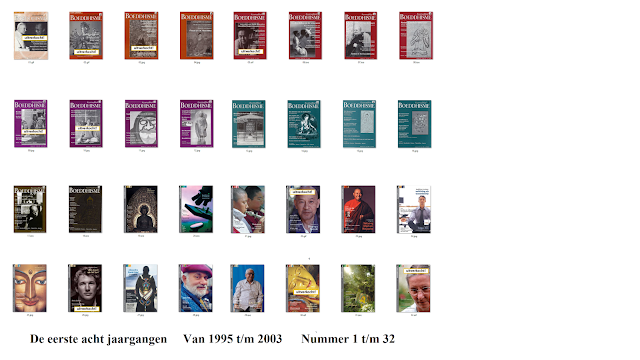
Het oudste nummer - # 28 uit zomer 2002 - dat ik heb, kende nog de Stichting Vrienden van het Boeddhisme (SVB, nu VvB) als uitgeefster, sinds 1995. Kort daarna werd Asoka de uitgever. Dit nummer heeft op de voorkant een foto van Bernie Glassman, met z'n bekende rode baret, hopelijk is die sindsdien een keer in de was geweest; en z'n verhaal over de Zen Peacemaker Orde. Verder een artikel - helaas nog steeds actueel - over de pijaflegging van monnik Dhammawiranatha door Paul Boersma.
Ik wil een recensie over # 79 schrijven alsof het de eerste keer dat ik dit tijdschrift lees; tenslotte zijn alle verschijnselen uniek: ze komen op en verdwijnen weer.
Maar voor mij is een recensie ook een uiting van verbazing. Als variant op de filosofische vraag 'waarom is er iets en niet veeleer niets' (Leibniz) vraag ik me af:
waarom is er zoiets als een papieren Nederlandstalig tijdschrift over het boeddhisme?
Hoewel 'Nederlandstalig'? Er zijn in de loop der jaren steeds meer illustraties en foto's in gekomen, sommige paginagroot. Hoeveel tekst had hier niet kunnen staan, denk ik dan; maar goed , ik ben ouderwets en nooit zo visueel ingesteld.

M'n recensie dan. De buitenkant is vrolijk met een vredesduif en is stevig en tegelijk aaibaar; glossy heet dat, geloof ik.
Eén van de artikelen gaat over de recent verschenen vertaling door Paul Boersma van de 'Dhammapada'. Daar heb ik recent al over geschreven. In plaats van de hier weergegeven verzen citeer ik hier het eerste vers van deze vertaling:
De geest gaat alle dingen voor,
Ze zijn door hem beheerst, gemaakt.
Als met verdorven geest men spreekt,
Als met verdorven geest men doet,
Dan komt hem lijden achterna,
Zoals het wiel de ossenhoef.
Ik citeer dit vers omdat het beschouwd wordt als positioneren van de Dhamma als idealisme.
Het thema van dit nummer is zoals gezegd 'idealisme', maar wat dat is, wordt niet omschreven. Het is niet het filosofische idealisme van de Dhammapada maar iets als: 'zichzelf wegcijferend strevend naar een betere wereld'. Hoewel ... in haar 'hoofdredactioneel ' zegt Marjolein Niestadt:
" 'Ik ben geen idealist', zegt boeddhistisch geestelijk verzorger Meindert van den Heuvel verderop in dit blad... Brigitte van Baren, die spiritualiteit in het bedrijfsleven brengt, benadrukt dat ze geen wereldverbeteraar is. En eco-ontwikkelingswerker Maarten Olthof maakte bij zijn interview bezwaar tegen de kop 'De idealenman'. "
Daarmee zijn gelijk al drie van de artikelen genoemd. Ik kan me de bezwaren van deze drie wel voorstellen: het is mooi werk wat ze doen maar het is wel werk, inkomen genererend, dus niet helemaal 'zichzelf wegcijferend'.
Ik ga niet alle artikelen noemen, laat staan bespreken. Wel het trio genaamd 'De Bron': 'BoeddhaBasics', 'de (Hart)Soetra uitgelegd' en 'de historische Boeddha': deze passen in een bewaarnummer. Ook de serie 'Vragen uit de dagelijkse meditatiepraktijk', dit keer over geleide meditaties, is steeds weer waardevol.
Artikelen van of over Tibetaans boeddhisten en Zen-boeddhisten noem ik wat minder maar spreken een ander weer aan: het is een blad van 'elck wat wils'. Een aantal van deze artikelen staan, met als datum '8 januari', op de website boeddhamagazine.nl/ .
Van het themagedeelte waardeer ik het meeste het openingsartikel '8 lessen voor idealisten' door Annemarie Opmeer, die ik ken van de vrolijke serie 'de faalboeddhist' op de site van Bodhitv. Ik noem de acht lessen: (1) woede werkt alleen met mededogen; (2) wees eerlijk tegen jezelf; (3) klamp niet vast aan identiteit; (4) geef de hoop op; (5) je vijanden zijn je vrienden; (6) rouw!; (7) opbranden kan ook als boeddhist; en (8) karma maakt je activist.
Terug naar het 'hoofdredactioneel' van Marjolein Niestadt. Zij sluit het als volgt af:
"En dan is er nog ons eigen bescheiden ideaal: een groter publiek laten kennismaken met het boeddhisme als inspiratiebron. Jammer genoeg draait BoeddhaMagazine al enige tijd verlies en is de toekomst uiterst onzeker.
Ook wij moeten ons ideaal kritisch onder de loep nemen. Is er nog wel een markt voor een breed toegankelijk boeddhistisch blad? Of bouwen we tegen beter weten in aan een luchtkasteel? Op dit moment weet ik het antwoord niet. Ik kan alleen zeggen dat ook wij gedreven worden door enthousiasme. Hopelijk is het genoeg om het blad te redden.
Ik hoop jullie snel weer te zien. "
Niet vrolijk, wel eerlijk, geen mooi weer spelen terwijl de schulden oplopen.
Wat betreft dat 'luchtkasteel' zou ik zeggen: nee, dat niet, Marjolein, maar we moeten ons realiseren dat er niet zoveel Nederlandse boeddhisten zijn, veel minder dan ze ons wijs hebben proberen te maken. Maar een procent of tien van de paar (twee?, vijf?) duizend lezende boeddhisten bereiken is toch ook heel mooi?
=====================================================================
Ook na het lezen van dit nummer meen ik dat een papieren tijdschrift voor de wat minder vluchtige mens - en dat is een boeddhist toch? - meerwaarde heeft boven alleen maar elektronische informatie zoals websites, tweets, blogs en 'journalistieke webmagazines'.
Er zijn gelukkig nog steeds mensen die een tekst van meer dan 5000 woorden aankunnen; 'longreads' heet dat tegenwoordig.
Maar het verschil is kleiner geworden; het lezen van papieren boeken vermindert ten koste van het lezen van ebooks. En er zijn al heel wat Engelstalige elektronische boeddhistische tijdschriften zoals het 'Journal of Buddhist Ethics ' en het 'Journal of Global Buddhism '; 'Lion's Roar ' is het elektronische samengaan van 'Shambhala Sun ' en 'Buddhadharma '. 'Tricycle ' heeft een digitale en een print versie. 'Inquiring Mind ' daarentegen gaat er komend voorjaar definitief mee stoppen: we (BoeddhaMagazine) zijn niet alleen.
Haalt tijdschrift 'BoeddhaMagazine' nummer honderd? Of eerst nummer tachtig? In papieren of in elektronische vorm? Ik zou het niet weten, heb er eerlijk gezegd een hard hoofd in, zeker in een papieren versie. Veel meer abonnee's werven lukt kennelijk niet. Ook het samenwerken met of overnemen door relatief rijke sangha's of BUN/BOS zou heilloos zijn.
Omzetten in een elektronische versie is nog het enige dat misschien haalbaar is; dat kan echter niet één op één met dezelfde redactieformule en dezelfde abonnees, en kan beter met een stichting in plaats van een BV als uitgever. En zwart-wit in plaats van kleurenplaten. Het enig denkbare alternatief van gewoon helemaal stoppen.
Wellicht kan genoemde website uitgebouwd worden, maar dan met enthousiaste vrijwilliger en met een mij onduidelijk of niet-bestaand verdienmodel (= quitte speel model).
Ik wil daar best met de redactie over meedenken. Een paar gedachten:
Om de twee maanden verschijnend. Dus geen 'blog' waarin onregelmatig als de auteur/eigenaar de geest heeft, iets verschijnt. Maar ook geen 'dagblad'; dus geen (quasi)nieuws en geen sentimentaliteiten. De lat moet eerder hoger gelegd worden ten opzichte van de huidige papieren BoeddhaMagazine dan lager. Wel minder rubrieken en minder artikelen dan de twintig die er nu in # 79 staan. Vertaalde en originele Nederlandse artikelen, maar ook onderzoeksjournalistiek werk.
Als de inhoud: de Dhamma/Dharma en informatie over wat er gebeurt in boeddhistisch Nederland en daarbuiten, maar verspreid blijft worden. Wellicht niet in een tijdloze vorm maar na een paar jaar nog steeds het nalezen waard.
Het is zeer gewenst dat de uitgever snel een beslissing neemt over het al dan niet voortbestaan dit jaar. (Update: hier heb ik een zin geschrapt die beschuldigend gelezen kon worden)
Ook is het zeer gewenst dat de redactie de discussie over de toekomst open maakt via het door mij geciteerde laatste deel van het 'hoofdredactioneel' op hun website te plaatsen en de lezers nadrukkelijk uit te nodigen tot reactie er op, ook via hun facebook- en twitter-account.

Aankondiging in →
http://boeddhamagazine.nl/ →
van begin januari 2015
Het werd de 16e januari
Eindconclusie: kopen dus
Wellicht wordt het een
'collectors item'
Nummer 79 in een telling waarin de voorgangers 'Kwartaalblad Boeddhisme' en
'Vorm en Leegte' meegeteld zijn.
Datum van verschijnen zou volgens de page 'BM adverteren' 5 december 2014 hebben moeten zijn. Volgens deze oorspronkelijke aankondiging zou het thema 'Natuur en milieu' zijn. Het is uiteindelijk 'Idealisme' geworden. De reden van de vertraagde verschijning van dit nummer wordt niet expliciet vermeld, het is duidelijk dat dit te maken heeft met de moeilijke financiële situatie, waarin Asoka (Milinda) verkeert, en BoeddhaMagazine in het bijzonder.

Het oudste nummer - # 28 uit zomer 2002 - dat ik heb, kende nog de Stichting Vrienden van het Boeddhisme (SVB, nu VvB) als uitgeefster, sinds 1995. Kort daarna werd Asoka de uitgever. Dit nummer heeft op de voorkant een foto van Bernie Glassman, met z'n bekende rode baret, hopelijk is die sindsdien een keer in de was geweest; en z'n verhaal over de Zen Peacemaker Orde. Verder een artikel - helaas nog steeds actueel - over de pijaflegging van monnik Dhammawiranatha door Paul Boersma.
Ik wil een recensie over # 79 schrijven alsof het de eerste keer dat ik dit tijdschrift lees; tenslotte zijn alle verschijnselen uniek: ze komen op en verdwijnen weer.
Maar voor mij is een recensie ook een uiting van verbazing. Als variant op de filosofische vraag 'waarom is er iets en niet veeleer niets' (Leibniz) vraag ik me af:
waarom is er zoiets als een papieren Nederlandstalig tijdschrift over het boeddhisme?
Hoewel 'Nederlandstalig'? Er zijn in de loop der jaren steeds meer illustraties en foto's in gekomen, sommige paginagroot. Hoeveel tekst had hier niet kunnen staan, denk ik dan; maar goed , ik ben ouderwets en nooit zo visueel ingesteld.

M'n recensie dan. De buitenkant is vrolijk met een vredesduif en is stevig en tegelijk aaibaar; glossy heet dat, geloof ik.
Eén van de artikelen gaat over de recent verschenen vertaling door Paul Boersma van de 'Dhammapada'. Daar heb ik recent al over geschreven. In plaats van de hier weergegeven verzen citeer ik hier het eerste vers van deze vertaling:
De geest gaat alle dingen voor,
Ze zijn door hem beheerst, gemaakt.
Als met verdorven geest men spreekt,
Als met verdorven geest men doet,
Dan komt hem lijden achterna,
Zoals het wiel de ossenhoef.
Ik citeer dit vers omdat het beschouwd wordt als positioneren van de Dhamma als idealisme.
Het thema van dit nummer is zoals gezegd 'idealisme', maar wat dat is, wordt niet omschreven. Het is niet het filosofische idealisme van de Dhammapada maar iets als: 'zichzelf wegcijferend strevend naar een betere wereld'. Hoewel ... in haar 'hoofdredactioneel ' zegt Marjolein Niestadt:
" 'Ik ben geen idealist', zegt boeddhistisch geestelijk verzorger Meindert van den Heuvel verderop in dit blad... Brigitte van Baren, die spiritualiteit in het bedrijfsleven brengt, benadrukt dat ze geen wereldverbeteraar is. En eco-ontwikkelingswerker Maarten Olthof maakte bij zijn interview bezwaar tegen de kop 'De idealenman'. "
Daarmee zijn gelijk al drie van de artikelen genoemd. Ik kan me de bezwaren van deze drie wel voorstellen: het is mooi werk wat ze doen maar het is wel werk, inkomen genererend, dus niet helemaal 'zichzelf wegcijferend'.
Ik ga niet alle artikelen noemen, laat staan bespreken. Wel het trio genaamd 'De Bron': 'BoeddhaBasics', 'de (Hart)Soetra uitgelegd' en 'de historische Boeddha': deze passen in een bewaarnummer. Ook de serie 'Vragen uit de dagelijkse meditatiepraktijk', dit keer over geleide meditaties, is steeds weer waardevol.
Artikelen van of over Tibetaans boeddhisten en Zen-boeddhisten noem ik wat minder maar spreken een ander weer aan: het is een blad van 'elck wat wils'. Een aantal van deze artikelen staan, met als datum '8 januari', op de website boeddhamagazine.nl/ .
Van het themagedeelte waardeer ik het meeste het openingsartikel '8 lessen voor idealisten' door Annemarie Opmeer, die ik ken van de vrolijke serie 'de faalboeddhist' op de site van Bodhitv. Ik noem de acht lessen: (1) woede werkt alleen met mededogen; (2) wees eerlijk tegen jezelf; (3) klamp niet vast aan identiteit; (4) geef de hoop op; (5) je vijanden zijn je vrienden; (6) rouw!; (7) opbranden kan ook als boeddhist; en (8) karma maakt je activist.
Terug naar het 'hoofdredactioneel' van Marjolein Niestadt. Zij sluit het als volgt af:
"En dan is er nog ons eigen bescheiden ideaal: een groter publiek laten kennismaken met het boeddhisme als inspiratiebron. Jammer genoeg draait BoeddhaMagazine al enige tijd verlies en is de toekomst uiterst onzeker.
Ook wij moeten ons ideaal kritisch onder de loep nemen. Is er nog wel een markt voor een breed toegankelijk boeddhistisch blad? Of bouwen we tegen beter weten in aan een luchtkasteel? Op dit moment weet ik het antwoord niet. Ik kan alleen zeggen dat ook wij gedreven worden door enthousiasme. Hopelijk is het genoeg om het blad te redden.
Ik hoop jullie snel weer te zien. "
Niet vrolijk, wel eerlijk, geen mooi weer spelen terwijl de schulden oplopen.
Wat betreft dat 'luchtkasteel' zou ik zeggen: nee, dat niet, Marjolein, maar we moeten ons realiseren dat er niet zoveel Nederlandse boeddhisten zijn, veel minder dan ze ons wijs hebben proberen te maken. Maar een procent of tien van de paar (twee?, vijf?) duizend lezende boeddhisten bereiken is toch ook heel mooi?
=====================================================================
Ook na het lezen van dit nummer meen ik dat een papieren tijdschrift voor de wat minder vluchtige mens - en dat is een boeddhist toch? - meerwaarde heeft boven alleen maar elektronische informatie zoals websites, tweets, blogs en 'journalistieke webmagazines'.
Er zijn gelukkig nog steeds mensen die een tekst van meer dan 5000 woorden aankunnen; 'longreads' heet dat tegenwoordig.
Maar het verschil is kleiner geworden; het lezen van papieren boeken vermindert ten koste van het lezen van ebooks. En er zijn al heel wat Engelstalige elektronische boeddhistische tijdschriften zoals het 'Journal of Buddhist Ethics ' en het 'Journal of Global Buddhism '; 'Lion's Roar ' is het elektronische samengaan van 'Shambhala Sun ' en 'Buddhadharma '. 'Tricycle ' heeft een digitale en een print versie. 'Inquiring Mind ' daarentegen gaat er komend voorjaar definitief mee stoppen: we (BoeddhaMagazine) zijn niet alleen.
Haalt tijdschrift 'BoeddhaMagazine' nummer honderd? Of eerst nummer tachtig? In papieren of in elektronische vorm? Ik zou het niet weten, heb er eerlijk gezegd een hard hoofd in, zeker in een papieren versie. Veel meer abonnee's werven lukt kennelijk niet. Ook het samenwerken met of overnemen door relatief rijke sangha's of BUN/BOS zou heilloos zijn.
Omzetten in een elektronische versie is nog het enige dat misschien haalbaar is; dat kan echter niet één op één met dezelfde redactieformule en dezelfde abonnees, en kan beter met een stichting in plaats van een BV als uitgever. En zwart-wit in plaats van kleurenplaten. Het enig denkbare alternatief van gewoon helemaal stoppen.
Wellicht kan genoemde website uitgebouwd worden, maar dan met enthousiaste vrijwilliger en met een mij onduidelijk of niet-bestaand verdienmodel (= quitte speel model).
Ik wil daar best met de redactie over meedenken. Een paar gedachten:
Om de twee maanden verschijnend. Dus geen 'blog' waarin onregelmatig als de auteur/eigenaar de geest heeft, iets verschijnt. Maar ook geen 'dagblad'; dus geen (quasi)nieuws en geen sentimentaliteiten. De lat moet eerder hoger gelegd worden ten opzichte van de huidige papieren BoeddhaMagazine dan lager. Wel minder rubrieken en minder artikelen dan de twintig die er nu in # 79 staan. Vertaalde en originele Nederlandse artikelen, maar ook onderzoeksjournalistiek werk.
Als de inhoud: de Dhamma/Dharma en informatie over wat er gebeurt in boeddhistisch Nederland en daarbuiten, maar verspreid blijft worden. Wellicht niet in een tijdloze vorm maar na een paar jaar nog steeds het nalezen waard.
Het is zeer gewenst dat de uitgever snel een beslissing neemt over het al dan niet voortbestaan dit jaar. (Update: hier heb ik een zin geschrapt die beschuldigend gelezen kon worden)
Ook is het zeer gewenst dat de redactie de discussie over de toekomst open maakt via het door mij geciteerde laatste deel van het 'hoofdredactioneel' op hun website te plaatsen en de lezers nadrukkelijk uit te nodigen tot reactie er op, ook via hun facebook- en twitter-account.

Aankondiging in →
http://boeddhamagazine.nl/ →
van begin januari 2015
Het werd de 16e januari
Eindconclusie: kopen dus
Wellicht wordt het een
'collectors item'
Abonneren op:
Posts (Atom)